
The complete guide
Choosing Your First Soprano Ukulele, A Practical Buyer's Guide
The problem with starting an instrument
Most people who say they want to learn an instrument never do. It is rarely about talent. It is about friction. A guitar is big, the strings hurt, and six of them is a lot to think about at once. A keyboard needs a stand, a power point and somewhere permanent to live. A violin needs a teacher almost immediately. By the time the instrument is set up and tuned, the five minutes of free time has gone.
A soprano ukulele removes most of that friction. Four nylon strings instead of six steel ones. A body you can hold under one arm. No cables, no power, no assembly. You pick it up, check the tuning, and play. That is the whole appeal, and it is why so many first instruments are ukuleles.
This guide covers what a 21 inch soprano actually is, how the materials shape the sound, who the size suits, and how to look after it so it still plays well in a year.
What a 21 inch soprano ukulele actually is
Ukuleles come in four common sizes. Soprano is the smallest and the oldest, and 21 inches is the traditional measurement. Concert, tenor and baritone step up from there, getting longer in the neck and larger in the body.
The size shapes two things. First, the scale length, which is the distance the strings vibrate over. A shorter scale means the frets sit closer together, so your fretting hand travels less to reach a chord shape. Second, the body volume, which affects tone. Smaller bodies tend to sound brighter and more clipped than larger ones.
This particular instrument measures 54 x 18 x 6.4 cm and weighs 0.9 kg. To put that in context, it is lighter than most school backpacks once the books are in. It has four strings tuned G C E A, the standard soprano tuning, which is the single most useful fact about it. Every beginner chord chart, every free lesson video and every tuner app is built around that tuning. You are never hunting for instructions written for your specific instrument.
How the wood changes what you hear
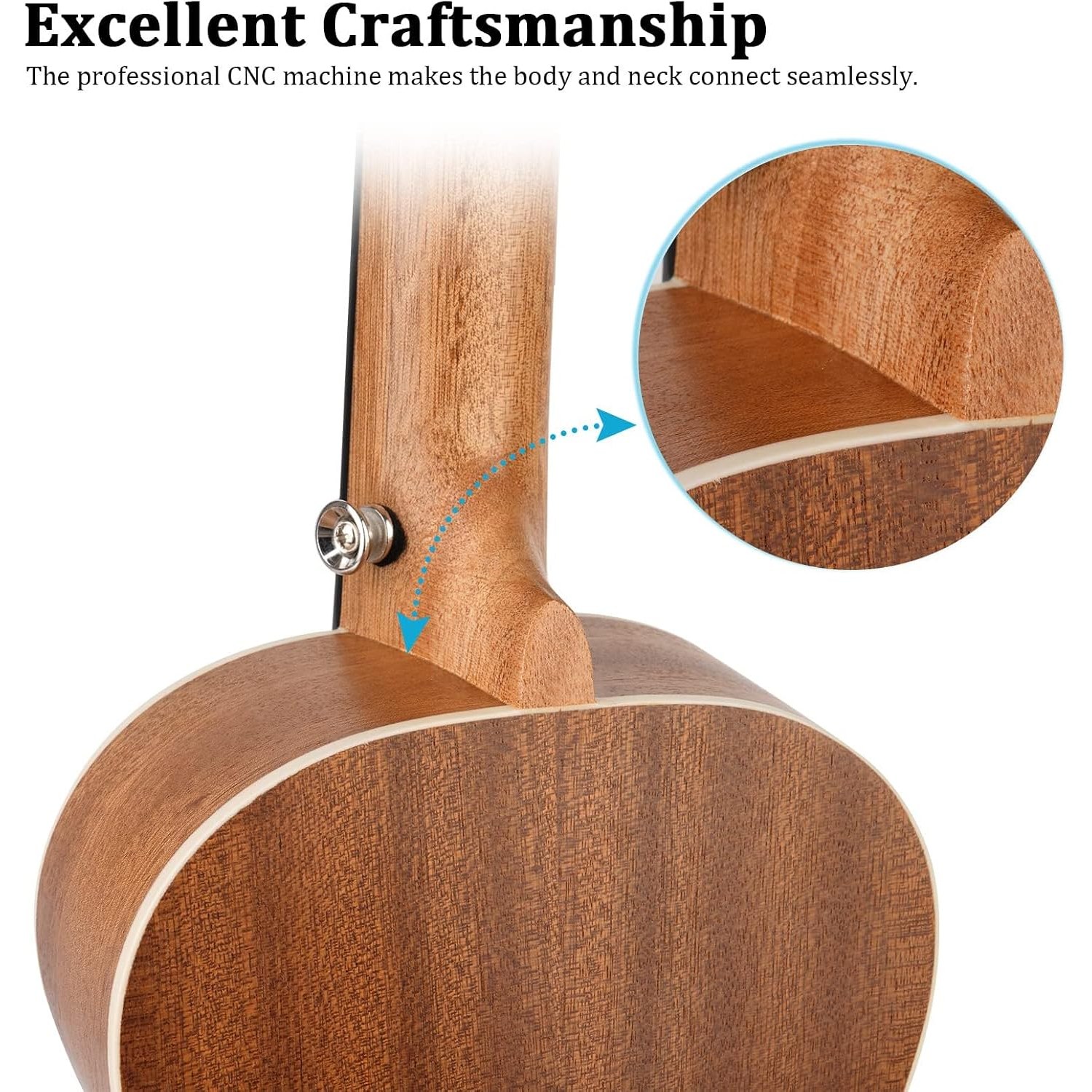
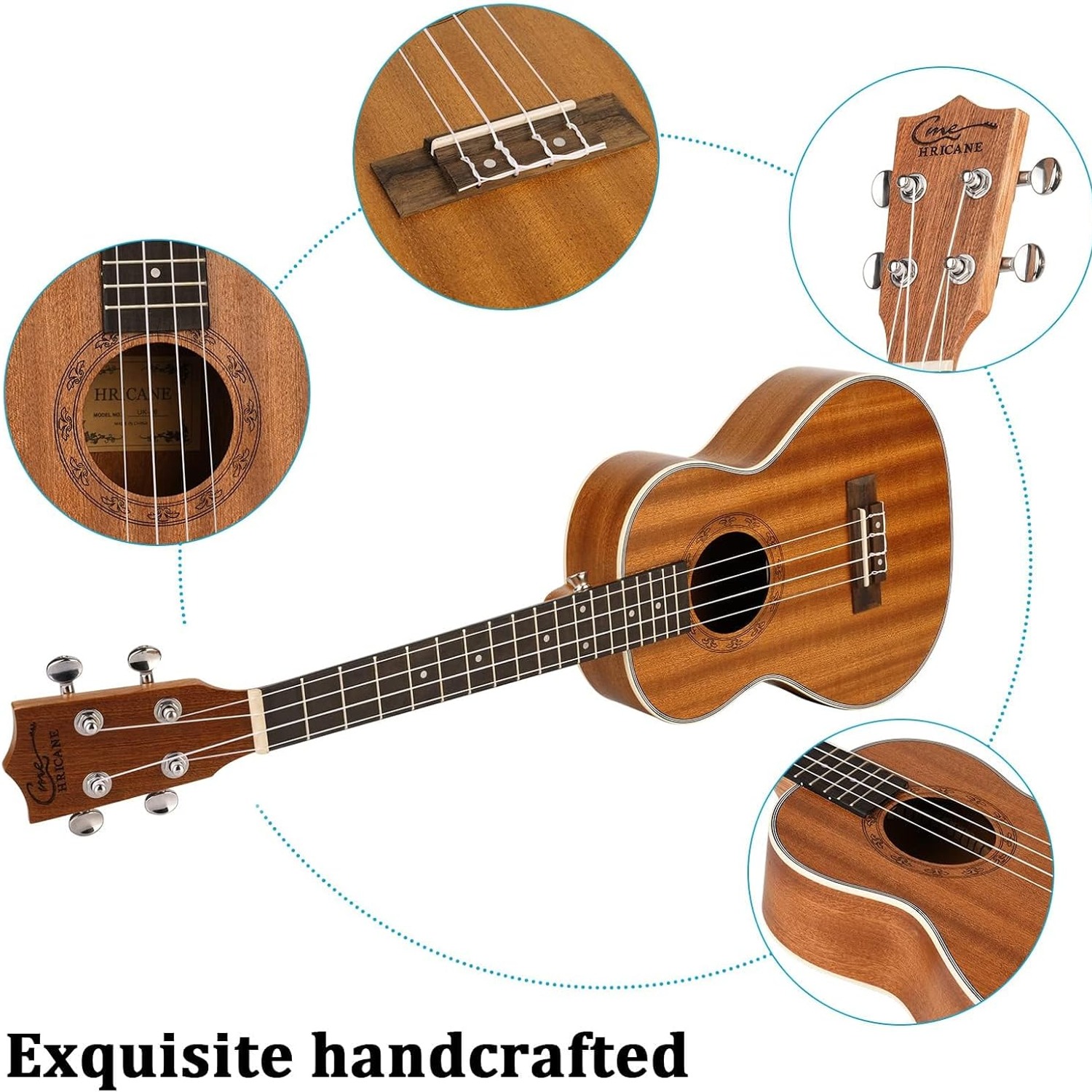
The top, back and body here are sapele, finished polished. Sapele is a hardwood with a look and grain close to mahogany, and it is widely used on entry and mid-level stringed instruments because it is stable and takes a finish well.
The practical result on an acoustic instrument is a sound the maker describes as balanced. Nothing is pushed hard in one direction. Strummed chords come out even, and single notes do not disappear underneath them. For a learner that is genuinely helpful, because a wildly uneven instrument makes it hard to tell whether a mistake is yours or the ukulele's.
The strings are nylon. Nylon is softer under the fingertips than steel, which matters enormously in the first fortnight. Steel strings on a guitar leave beginners with sore fingers and a very good excuse to stop. Nylon is kinder, and most people get through the early tenderness in a week or two of short daily sessions.
One honest note on expectations. An acoustic ukulele of this size is a quiet instrument. Strummed at a normal effort it sits around conversation volume. That is a feature in a flat or a shared house, and a limitation if you want to be heard across a noisy room.
Who this size suits
Children are the obvious group. A 0.9 kg instrument that is 54 cm long sits against a small chest without a fight, and the close fret spacing means short fingers can actually reach a chord. Anyone looking for a small ukulele for kids is usually looking at soprano whether they know the terminology or not.
Adults are the less obvious group, and they buy plenty of sopranos. If you have average hands, the spacing is fine after a short adjustment. If you have large hands, you may find the frets cramped up near the body, in which case a concert or tenor gives you more room. Try pressing your index, middle and ring fingers side by side on a ruler. If they span more than about four centimetres, consider sizing up.
The size also suits anyone who travels. A ukulele that fits in a car footwell or a holiday suitcase gets played. A guitar that lives in a cupboard does not.
What comes in the box, and why it matters
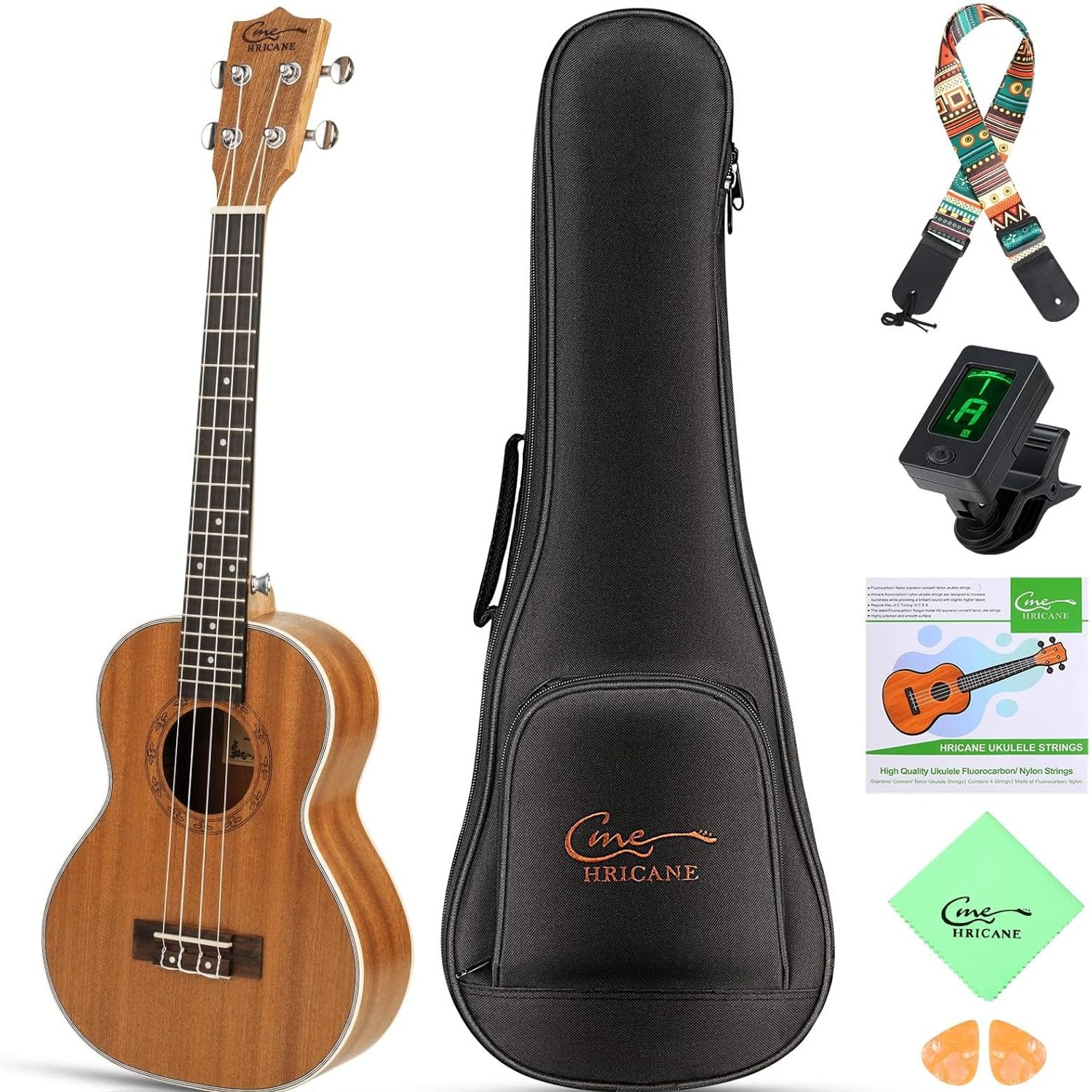
This ships with the ukulele, a carry bag and a spare string set.
The bag does more than you might assume. It keeps dust off the strings, protects the polished finish from the knocks a cupboard delivers, and turns the instrument into something you take with you rather than something you leave behind. An instrument that travels gets picked up more often.
The spare strings matter for a different reason. Nylon strings stretch when new, dull over months of playing, and break occasionally. When that happens to someone three weeks into learning, having a replacement set already in the bag pocket is the difference between a twenty minute fix and a hobby quietly ending. Keep the spares with the instrument, not in a drawer.
What is not confirmed in the maker's details, and so what we will not promise, is a tuner, a strap, picks or a printed chord chart. If you want those, buy them separately. A clip-on tuner is the one accessory worth adding straight away, though a free phone app does the job perfectly well.
Tuning, the thing everybody underestimates
New nylon strings stretch. For the first week or so, expect the ukulele to drift out of tune within a single practice session. This is normal and it is not a fault. Tune, play, tune again, and after a few days things settle.
Use a tuner app or a clip-on tuner and match each string to G, C and E and A. Do not try to learn by ear at the start, because a beginner tuning by ear usually ends up tuning to a wrong reference and wondering why nothing sounds right.
Temperature and humidity also move tuning. A ukulele brought in from a cold car will need adjusting once it warms up. Give it ten minutes to settle before you fight with the pegs.
Looking after it
Care is simple and mostly about where it lives.
Wipe the body and strings with a soft dry cloth after you play. Skin oils are what kill nylon strings early, and thirty seconds with a cloth doubles their useful life. Skip household cleaners on the polished finish.
Store it in the bag in a room with reasonably stable conditions. The enemies are direct sun through a window, the top of a radiator, a damp garage and a car boot in summer. Wood expands and contracts with heat and moisture, and sudden swings affect both tuning and the long-term health of the instrument.
If it will sit unused for months, slacken very tight strings a little to ease the tension. Retune before the next session and give the strings a day to settle again.
When strings sound dull, refuse to hold pitch, or look grubby where your fingers land, change them. That is what the spare set is for.
One thing to confirm before you order
The maker lists hand orientation as left. If the player is particular about handedness, message us before ordering and we will confirm exactly what is being sent. We would rather answer a question first than deal with a return later.
It is also worth saying that plenty of left-handed beginners learn right-handed without difficulty, since both hands are doing real work on a stringed instrument. If you are undecided, a single lesson with a teacher will settle it faster than reading opinions online.
The short version
A 21 inch soprano ukulele is the easiest acoustic instrument to start on, and this one is a proper instrument rather than a toy. The sapele top, back and body with a polished finish give a balanced sound, the four nylon strings tune to standard G C E A so every lesson online applies, and at 54 cm and 0.9 kg it goes everywhere without complaint.
The bag and spare strings mean you are not placing a second order before you can play. Buy it if you want something small, quiet and genuinely playable that a child or an adult can pick up this week. Size up to a concert or tenor only if large hands make the fret spacing feel tight.