

The complete guide
Dinosaur Race Track Sets, A Practical Buyer's Guide
The problem with most toy cars
A toy car on its own runs out of ideas quickly. A child pushes it across the floor, makes an engine noise, and within a few minutes it is parked under the sofa with the rest of them. What keeps cars interesting is somewhere to drive. Give a child a road that climbs, bends and crosses itself, and the same car suddenly has a job to do.
That is the thinking behind a flexible race track for kids. Instead of a fixed oval printed on a board, you get a pile of track sections and the freedom to decide where the road goes. The circuit becomes the project. The car is the payoff.
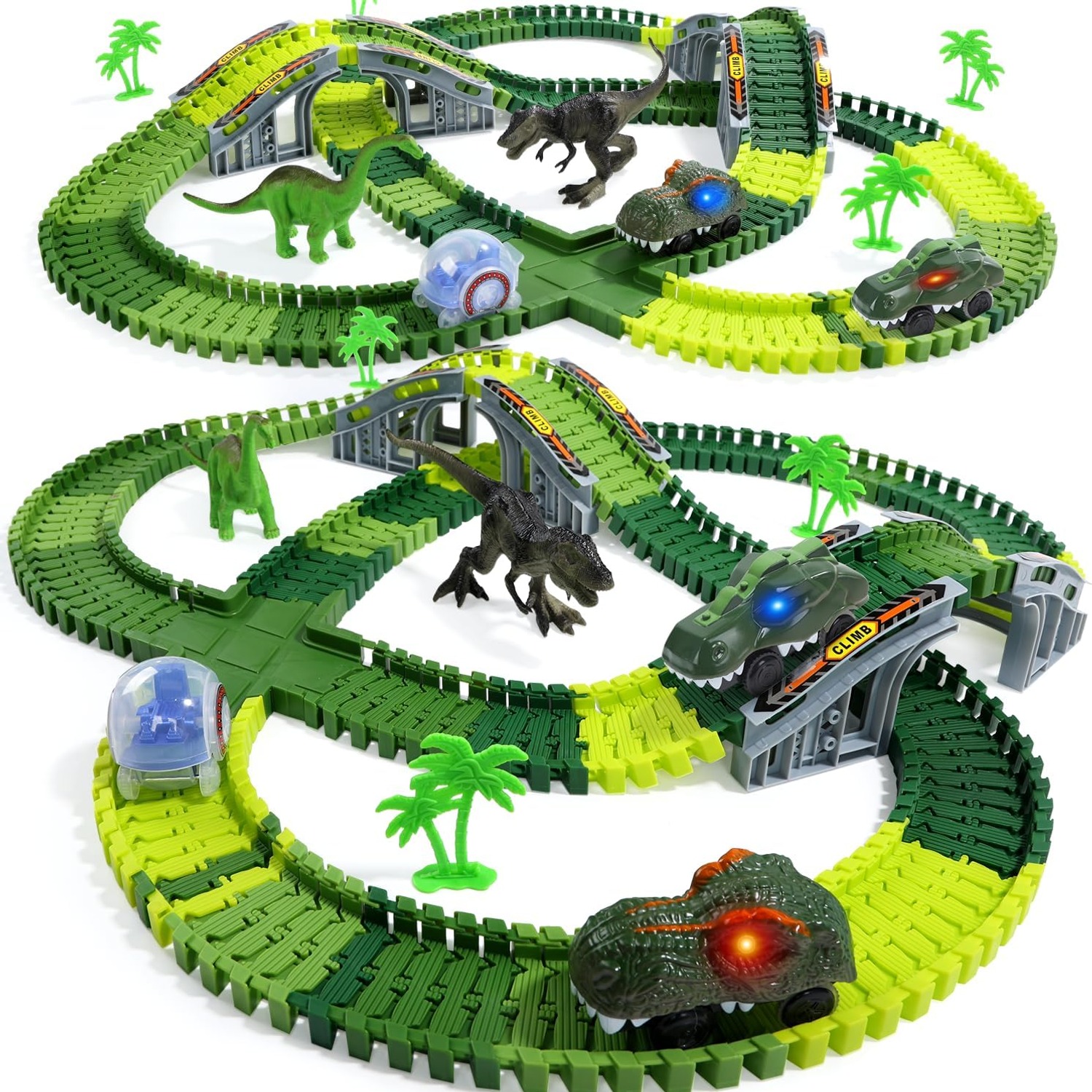
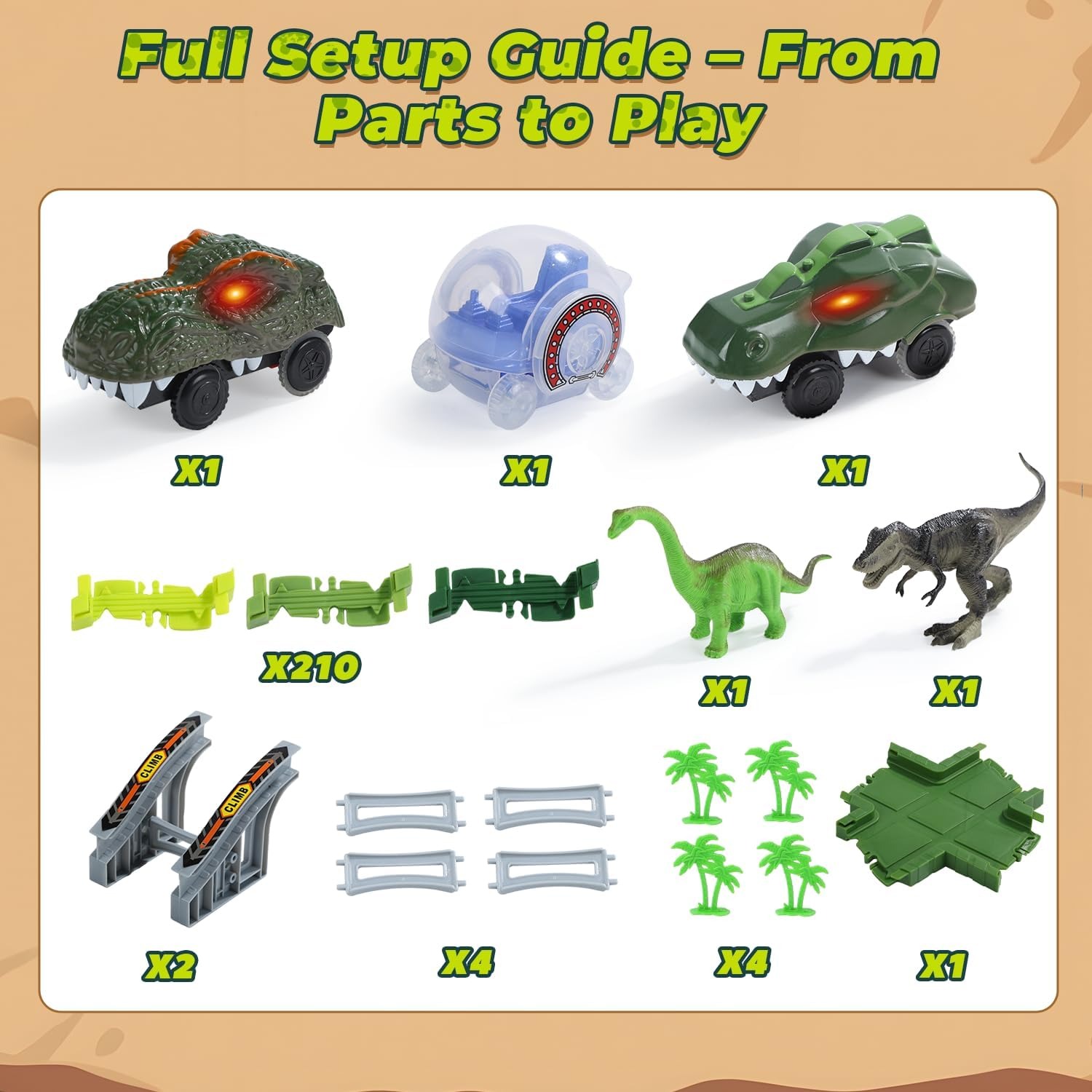
This EagleStone set takes that idea seriously. It has 233 pieces, 210 of which are track. That is a long road. It is enough to run a loop around a rug, climb over a cushion, pass through the legs of a chair and come back again.
How a flexible track set actually works
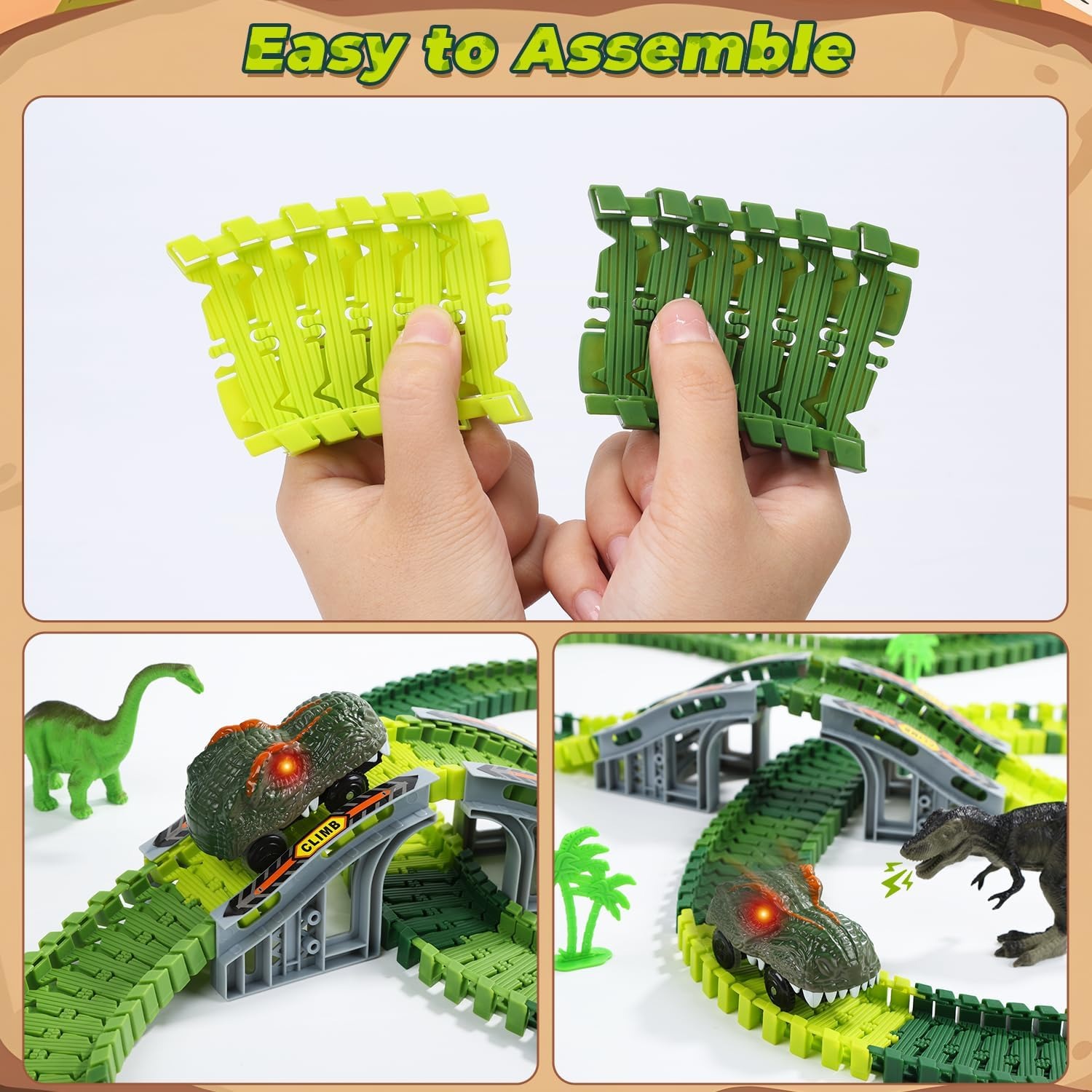
The track pieces are soft and bendable rather than rigid. They snap together end to end, and because they flex, a straight run can be curved into an arc by hand. That one feature changes everything about how the toy gets used. Rigid track forces you into the shapes the manufacturer thought of. Bendable track lets a six year old look at the gap between the coffee table and the wall and decide the road is going through it.
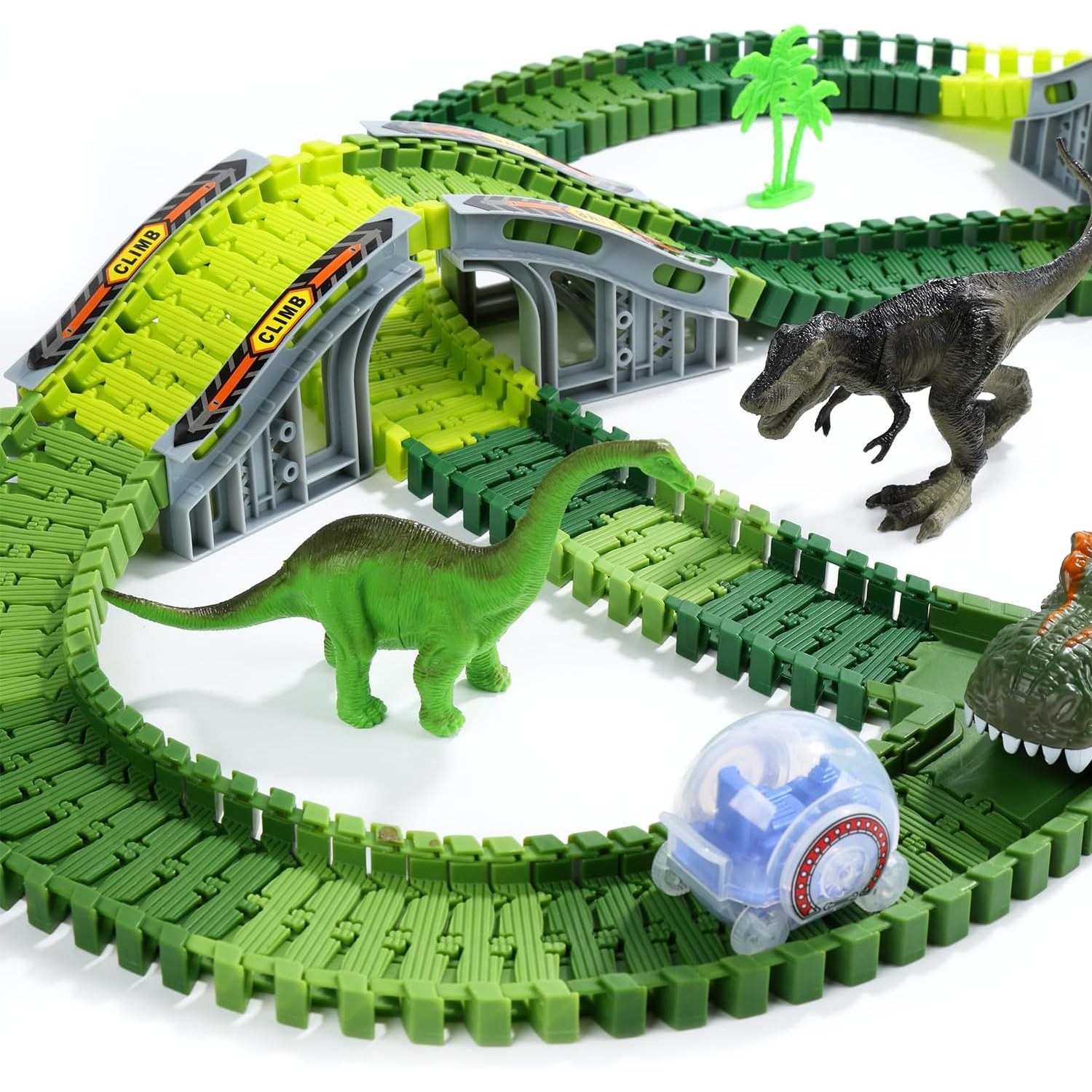
The set also includes bridge supports and slope connectors. These lift sections of track off the ground so the circuit can rise and fall. A hill is more interesting than a flat lap, and a child who has just built one will want to see whether the car makes it to the top. There is a four-way crossroad too, which is the piece that turns a single loop into something resembling a road network.
Then there are the cars. Two electric dinosaur cars with lights do the running. Press the button and they go, following the route you laid out, headlights glowing. They are listed as automatic operation with push button control, so there is no steering to learn and no remote to lose. A third vehicle, the slide explorer car, has no motor. A dino car pushes it from behind. That sounds like a small detail, and it is the thing children remember most. It stops being a race and becomes a ride through the park.
Rounding out the scene are a Tyrannosaurus Rex, a Brachiosaurus and four palm trees. They do not move or light up. They just give the track somewhere to be, and that is usually enough for a story to start.
Who this suits
The manufacturer lists the age range as 36 months to 12 years, with a minimum of 36 months and a beginner skill level. That is a wide span, and it plays out differently at each end.
A three or four year old will want help with the first build. The connectors are simple, but working out how a long run of track fits into the space available is a planning job, and planning is exactly the skill that is still developing at that age. Build it together the first few times. After that they will start making changes on their own, which is the moment the toy really earns its keep.
From about five upwards, children tend to take over entirely. They will try tall ramps, see them collapse, and work out why. They will build a circuit that crosses itself and argue about who has right of way at the crossroad. The listed educational objectives are cognitive skill, hand-eye coordination, imagination development and creative thinking, and that is a fair description of what is going on while they tinker.
Older kids near the top of the range usually move toward design challenges. How long can the track be. Can it run from the bedroom into the hallway. Can both cars share the circuit without a collision. That is where a 210-piece track length pays off.
It also works well for two children at once. There are two motorised cars, so nobody is waiting a turn, and building a layout together is a cooperative job rather than a competitive one.
How to choose a track set
A few things separate a set that lasts from one that gets shelved.
Track length. This is the single biggest factor. A set with 40 pieces builds one small loop and you have seen everything it can do by the end of the first day. A set with 210 pieces can be rebuilt into a genuinely different layout every time. If you are comparing a dinosaur car track toy against alternatives, count the track pieces before you count anything else.
Flexibility. Bendable track is more forgiving than rigid track. A slightly imperfect join still works, and the shapes available are not limited to a fixed set of curves. For a younger builder this matters a lot, because frustration is what ends play sessions early.
Vehicle type. Motorised cars keep going on their own, which means a child can stand back and watch the circuit they built actually work. That feedback loop is what makes them want to build again. Push-along cars need constant input and tend to run out of steam.
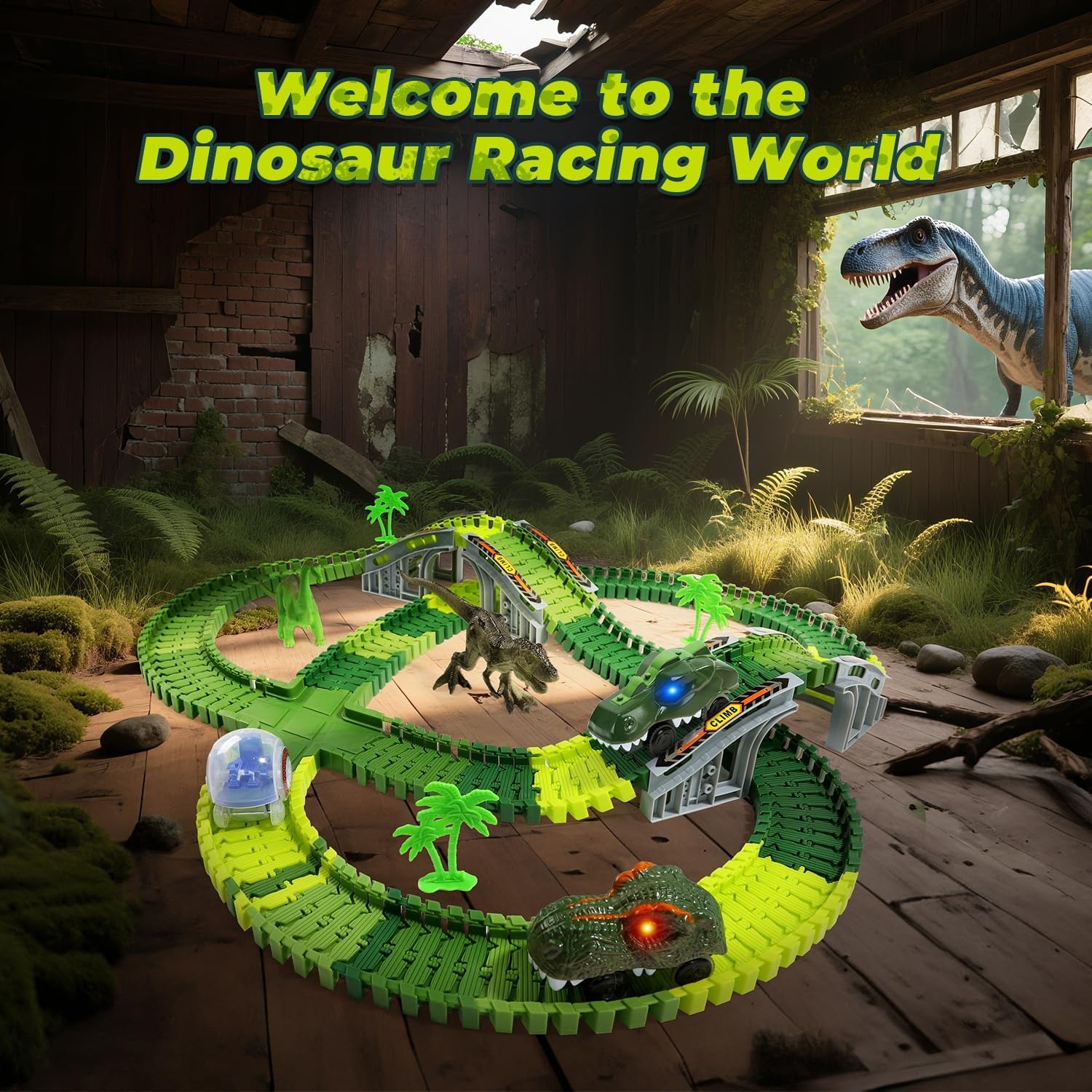
Theme and figures. A plain track is a track. Add a T-Rex and some palm trees and it becomes a place. The figures in a dinosaur play set with figures give the cars a reason to be driving somewhere, which is where imaginative play comes from.
Pack-away. Anything that cannot be dismantled takes up permanent floor space. Modular track goes back in a tub in a few minutes. With the item dimensions listed at 9.4 x 19.6 x 25.1 cm, the box itself is small enough to live on a shelf between sessions.
Setting up and looking after it
Pick your surface before you start. Hard floors, rugs and low pile carpet all work well. Deep pile can lift sections unevenly and slow the cars down, so if that is all you have, a large flat mat or a play rug solves it.
Budget around 20 minutes for the first build, which is the figure the manufacturer gives. Later builds go quicker. A useful approach with a younger child is to lay out the general shape of the loop first with straight track, then add hills and the crossroad once the basic circuit is proven to run.
The cars are battery powered and the listing states that no batteries are included. Check the compartment and buy the right size before a birthday or Christmas morning. A toy that cannot be switched on is a disappointing unwrapping.
For cleaning, a damp cloth on the track pieces and figures is all that is needed, then dry them before putting the set away. Do not submerge anything, and keep liquid well away from the electric cars. If the set is going into storage for a while, take the batteries out so they cannot leak.
Storage is simple. Break the circuit into sections, stack the track flat and keep connectors and small parts in the same container. The main way these sets degrade is not breakage, it is pieces going missing one at a time under furniture. A quick sweep of the room at pack-up time prevents that.
The short version
If you want a toy that gets rebuilt rather than outgrown, a flexible track set is a good bet, and the piece count is what decides how long it stays interesting. This one gives you 233 pieces with 210 of them being bendable track, two motorised dinosaur cars with lights, a push-along explorer car, two dinosaur figures, palm trees and a four-way crossroad. It is made from ABS plastic, rated for ages 36 months to 12 years, needs about 20 minutes to assemble and comes apart for flat storage.
Supply the batteries, clear a patch of floor, and let the layout be the child's decision. That is where the value is.