
The complete guide
Choosing a Dinosaur Transport Truck Set, A Buyer's Guide
The problem with most toy trucks
Buy a child a toy truck and you often get about twenty minutes of interest. The truck rolls. It is pushed across the room. Then it sits under the couch until someone trips over it. The reason is simple. A truck on its own is a vehicle without a job.
A car carrier truck toy fixes that, because it comes with a job built in. There are things to load. There are things to unload. There is a reason to drive from one side of the lounge to the other and back again. Children who lose interest in a single toy car will happily spend forty minutes loading twelve small vehicles into a trailer, closing the hatch and starting the run.
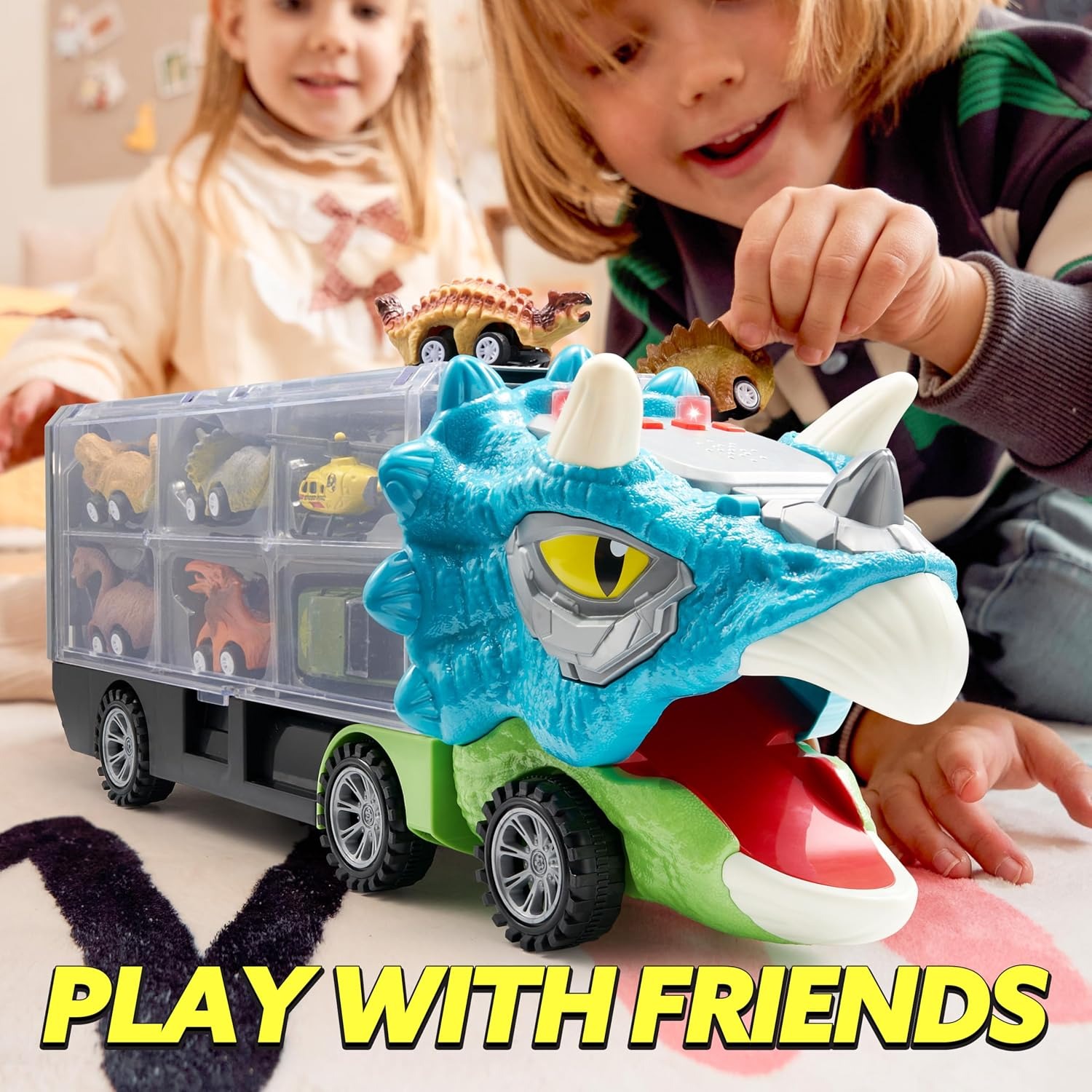
This particular set leans on a second hook as well, which is dinosaurs. The truck is modelled on a Triceratops, the mini cars carry dinosaur styling, and pressing the sound button sets off roars alongside the engine noise. Dinosaurs are one of the few themes that hold a child's attention for years rather than weeks.
What you actually get
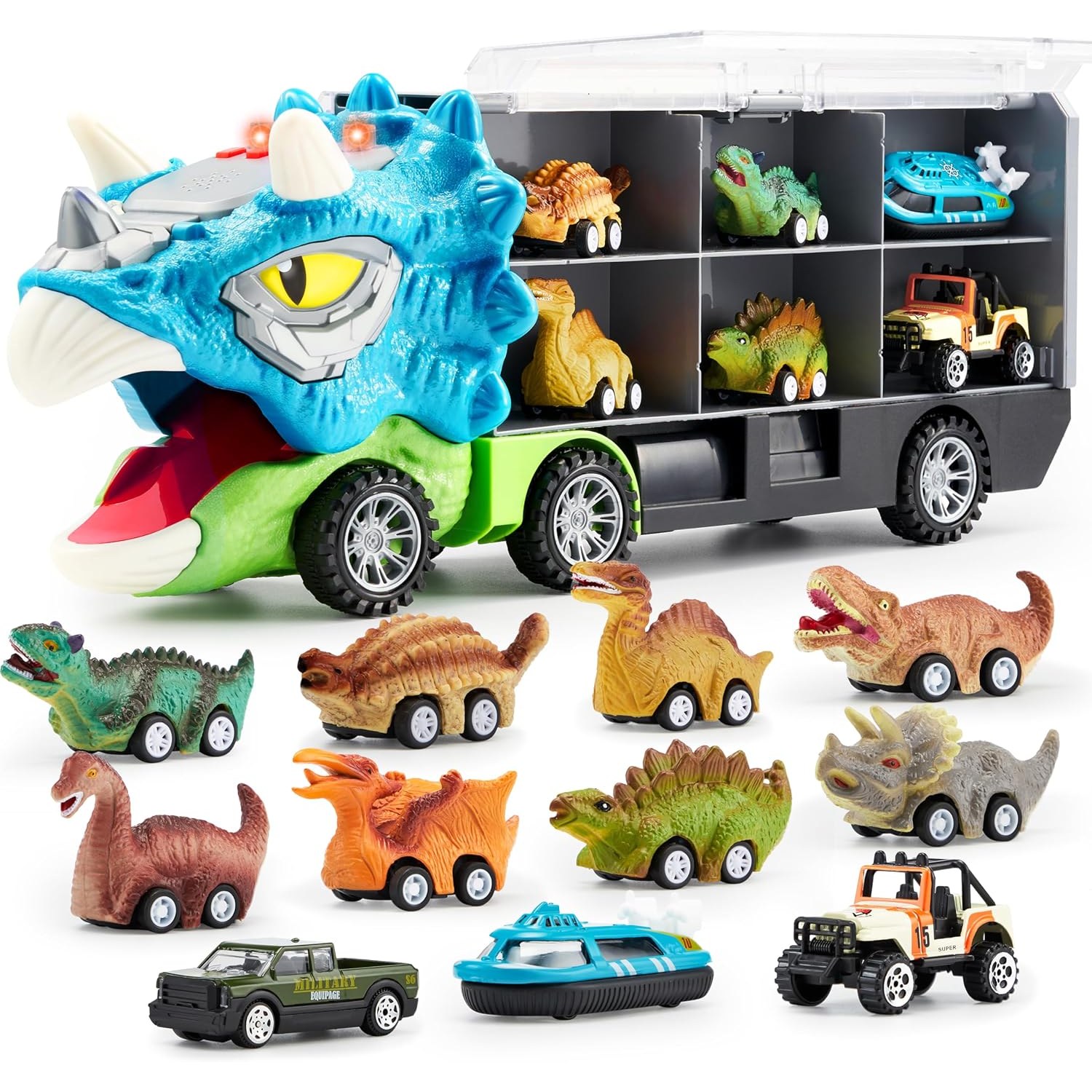
Thirteen pieces, which breaks down as one large carrier truck and twelve mini vehicles.
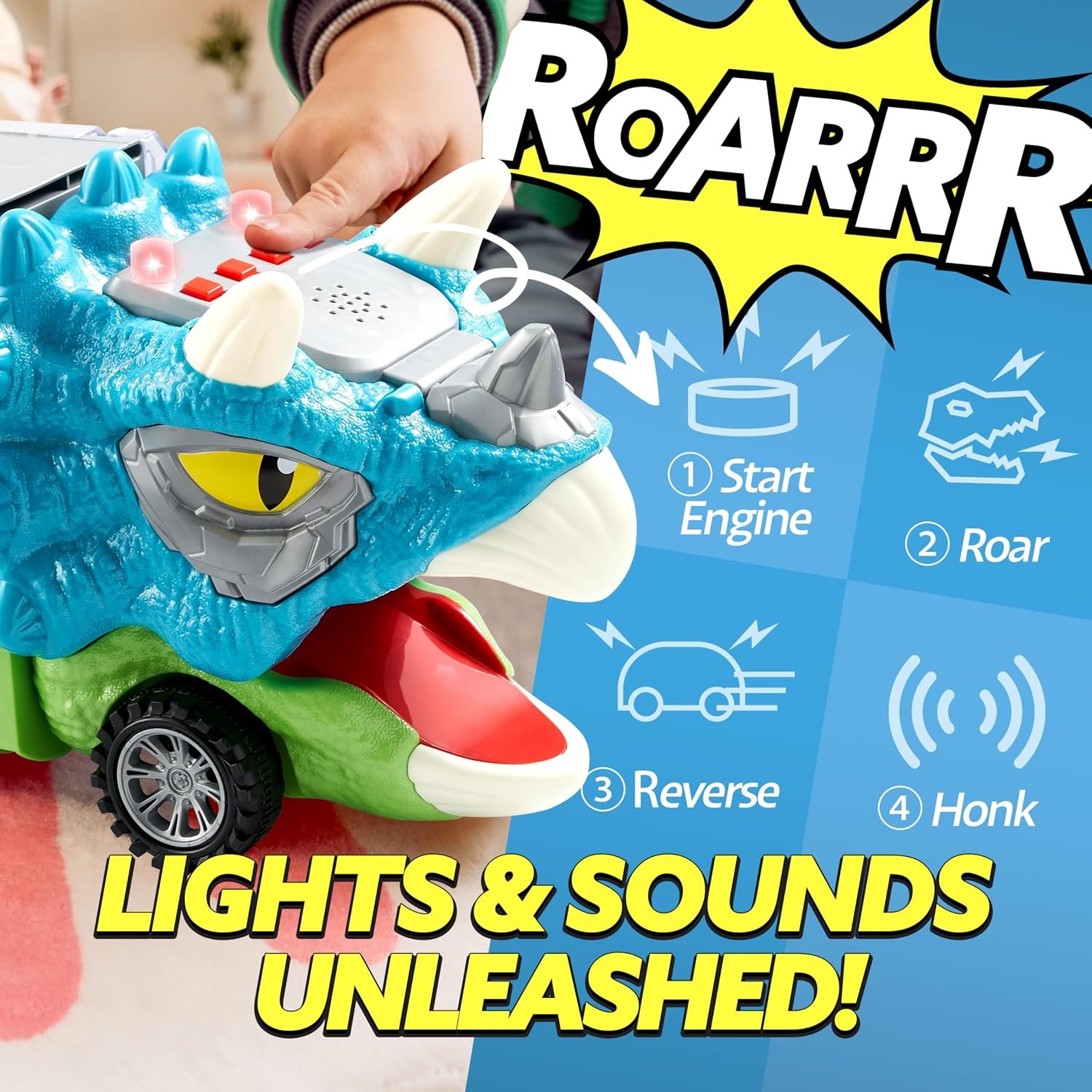
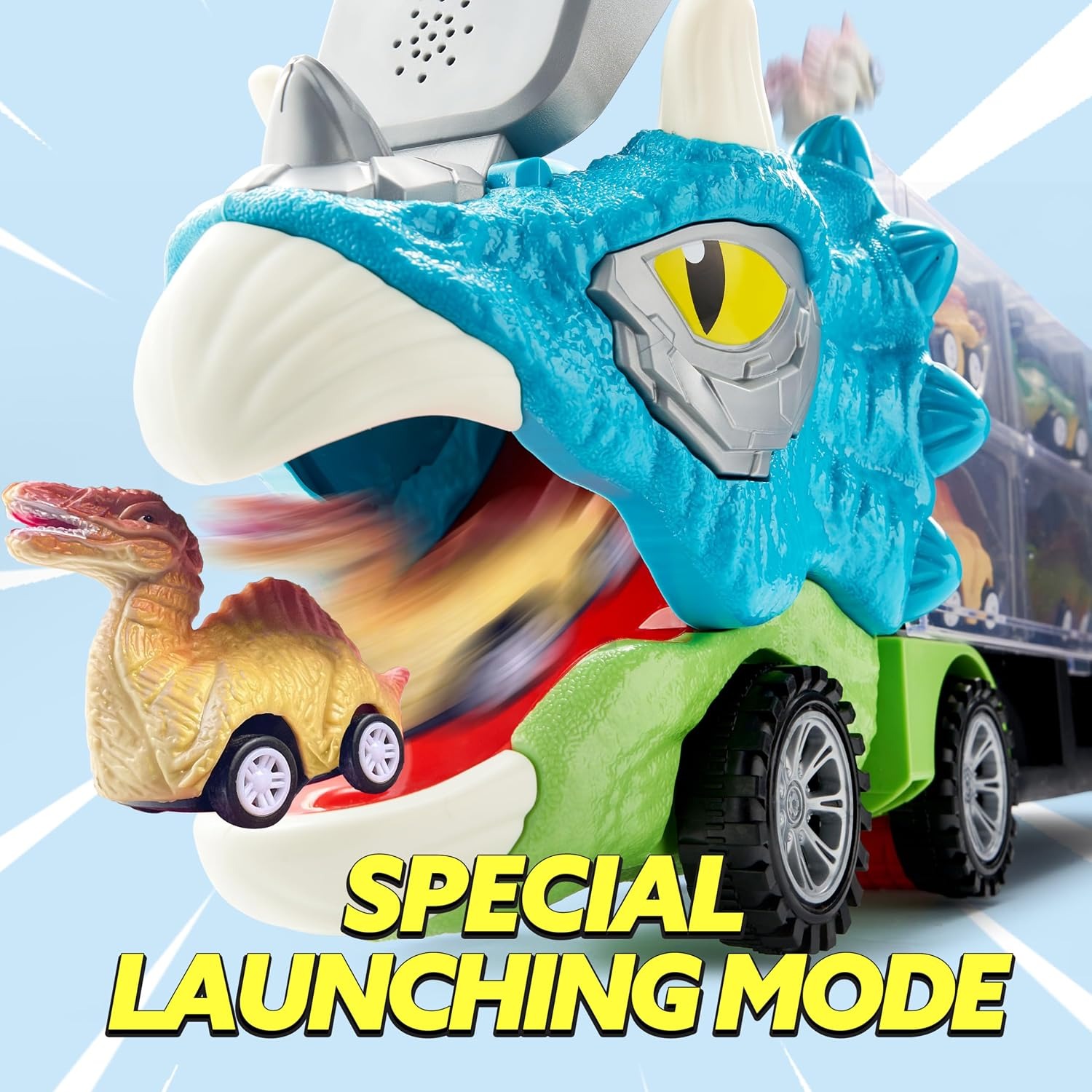
The truck is the centrepiece. It measures 44 x 16 x 11 cm, which is big enough to feel like a proper toy and small enough to push around a bedroom floor. The head flips open so the vehicles slide in and out along the deck. A sound button on the body triggers seven simulated sounds, covering engine start-up, reversing, dinosaur roars, a horn and an emergency siren, with lights running alongside.
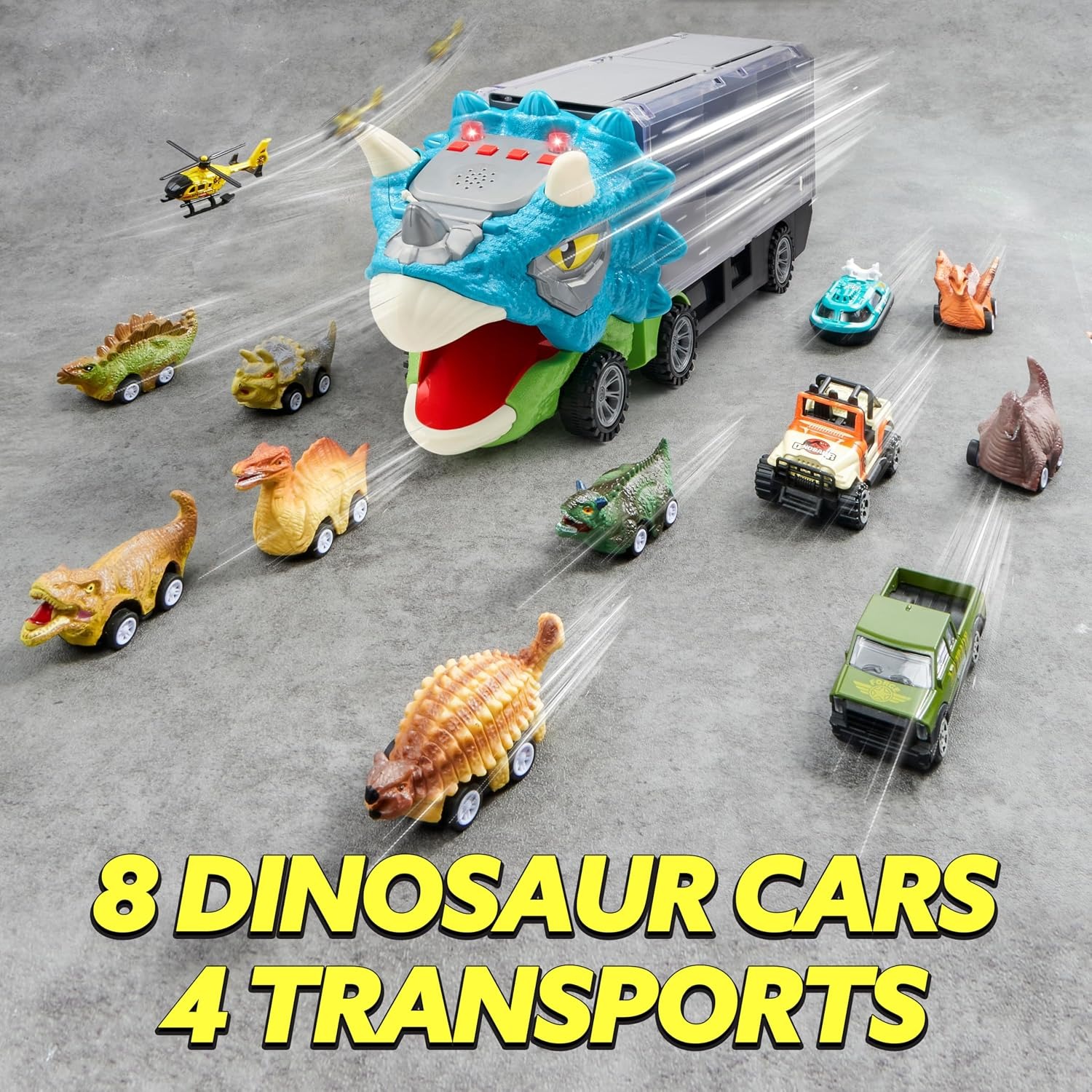
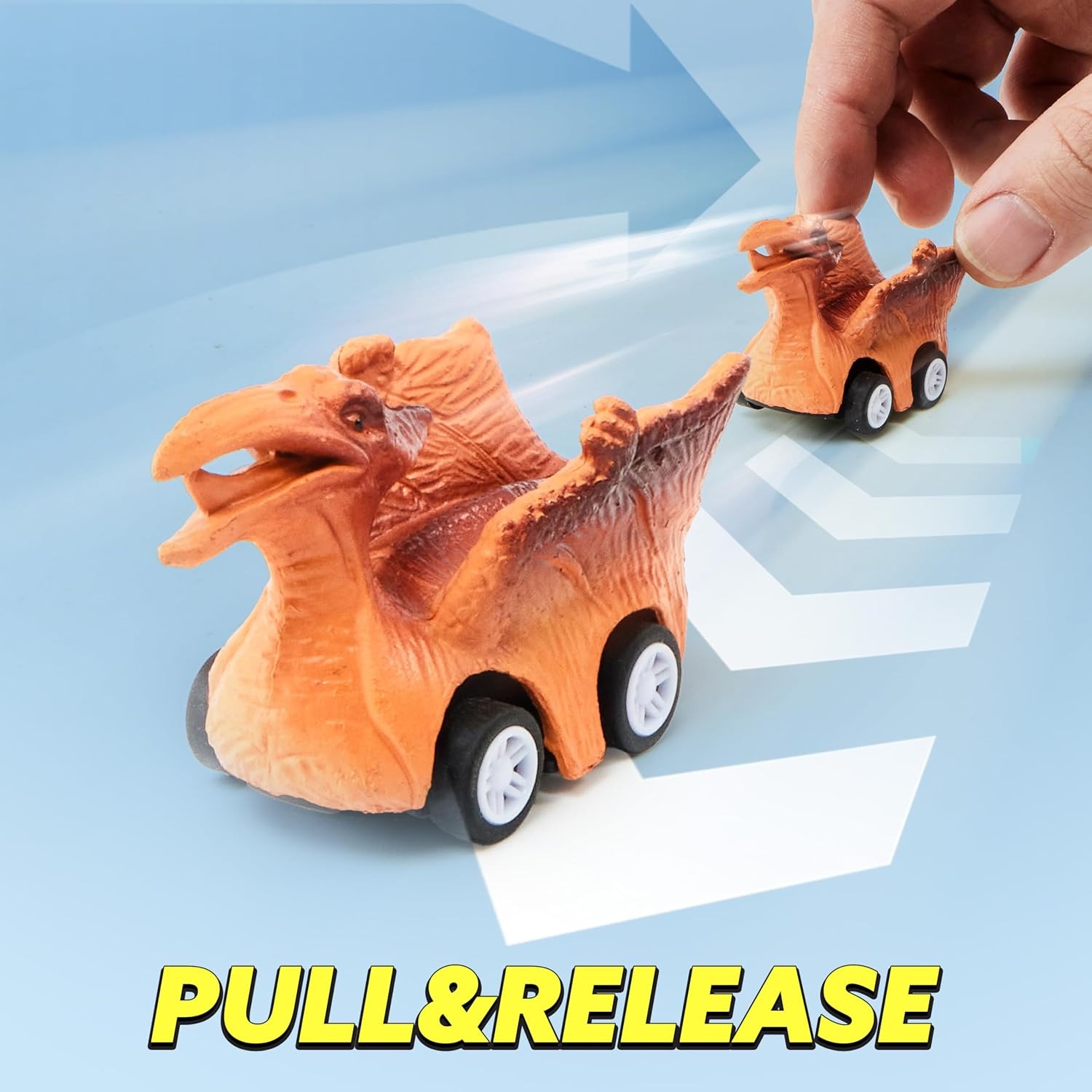
The twelve mini vehicles come in three types. Eight are pull back dinosaur cars, which run on a spring mechanism rather than batteries. Three are die-cast dinosaur vehicles with metal bodies and a bit of heft. The last is a helicopter.
The whole set weighs 1.15 kg and is made of plastic. No assembly is needed, which matters more than people expect when the box is being opened at a birthday party.
How pull back cars work, and why children love them
Pull back cars have been around for decades and the mechanism has not changed much. Inside each car is a coiled spring attached to the rear axle. Drag the car backwards along a flat surface and the wheels wind the spring. Let go and the spring unwinds, driving the wheels forward.
The appeal for young children is cause and effect. They do something small and get a big result. There is no switch, no remote and no battery to flatten, so the car works every single time. For a three year old still building fine motor control, that reliability is worth a lot.
Surface makes a real difference. On tiles, polished boards or a smooth table, the cars travel a satisfying distance. On thick carpet they barely clear a metre, because the pile grabs the wheels. If your main play space is carpeted, a low-pile rug or a hard floor area gives the best results.
The three die-cast vehicles behave differently. They are heavier and roll by hand rather than launching themselves. Children usually notice the weight difference straight away and treat the die-cast ones as the special cars.
Who it suits
The manufacturer recommends ages 3 and up. In practice the sweet spot runs from about three to seven.
A three or four year old gets most of their enjoyment from the loading routine and the sound button. The repetition is the point. Load, close, drive, open, unload, repeat. It looks dull to an adult and is deeply absorbing to a preschooler.
A five to seven year old starts building stories. The helicopter becomes a rescue unit. One of the die-cast vehicles becomes the boss. The siren means something has gone wrong on the road. This is where a set like this earns its keep, because twelve separate vehicles give a child enough characters to run a proper narrative.
Children under three should be supervised, as with any set that includes small vehicles. Follow the age guidance printed on the packaging.
How to choose between sets like this
A few things are worth checking before you buy any transport truck toy.
Piece count versus piece quality. A set with thirty flimsy cars is not better than a set with twelve solid ones. Here you get a mix, with eight pull back cars and three die-cast vehicles, so there is variety in feel as well as number.
Does everything store inside? This is the quiet practical test. If the truck holds all the vehicles, the set tidies itself. If the cars live loose in a toy box, half of them will vanish within a month. The flip-open head on this truck means all twelve load back in.
Sound and lights, yes or no? Some parents want them, some do not. Button-triggered sound is the middle ground, because the toy stays quiet until a child chooses to set it off. That is different from toys that chirp every time they are knocked.
Assembly. Anything that needs building before play creates a gap between opening the gift and using it. This set needs none.
Size. At 44 cm long, this is a floor toy rather than a shelf ornament. Check you have somewhere to keep it, whether that is a toy box, a deep shelf or the bottom of a cupboard.
Looking after it
The care routine is short. Wipe the truck and the vehicles with a soft, damp cloth and dry them before putting them away. Do not soak the truck or put any part through a dishwasher, since the sound and light section contains electronics.
Keep the set out of direct sun and away from heaters. Plastic that bakes in a car boot or a sunny window over a summer will go brittle and fade.
Check the small vehicles every so often for cracked plastic or loose wheels, and retire any piece that has broken. The pull back mechanism is sealed inside each car and is not designed to be opened.
Store everything inside the truck. It sounds obvious, but it is the single habit that keeps a thirteen piece set at thirteen pieces.
The short version
This is a 13 in 1 dinosaur set built around a 44 cm Triceratops-themed carrier truck with lights and seven simulated sounds. Inside it sits a fleet of twelve, eight pull back dinosaur cars, three die-cast dinosaur vehicles and one helicopter, all of which load and unload through a flip-open head.
It needs no assembly, weighs 1.15 kg, is made of plastic and is recommended for ages 3 and up. The loading routine gives younger children a repeatable task that builds coordination, and the variety of vehicles gives older children enough characters to invent stories around.
If you want one box that keeps a preschooler busy, stores itself tidily and does not need a parent to build it first, this does the job.