Toy Warehouse
Company
Shop By Category
T&Cs
Shop Online
  • Box contents listed
  • Free tracked NZ-wide delivery over $175
  • 14-day returns

Four in a Row Game | Family board game | Line up four game

4 in a Row Connect Board Game

$54.99 $65.99 Save $11
  • Rules In Seconds
  • 48 Discs Included
  • Packs Up Flat
  • Quiet Thinking Practice

Price: $54.99 $65.99

  • Free tracked NZ-wide delivery on orders $175+, otherwise a flat $20
  • Pay by card or PayPal, handled by the payment provider
  • 14 days to change your mind, plus your statutory rights
Product specifications
BrandPup Go
Set NamePup Go 4 in a Row Connect Board Game
Model NumberNO.17819
ManufacturerSHUANGDI
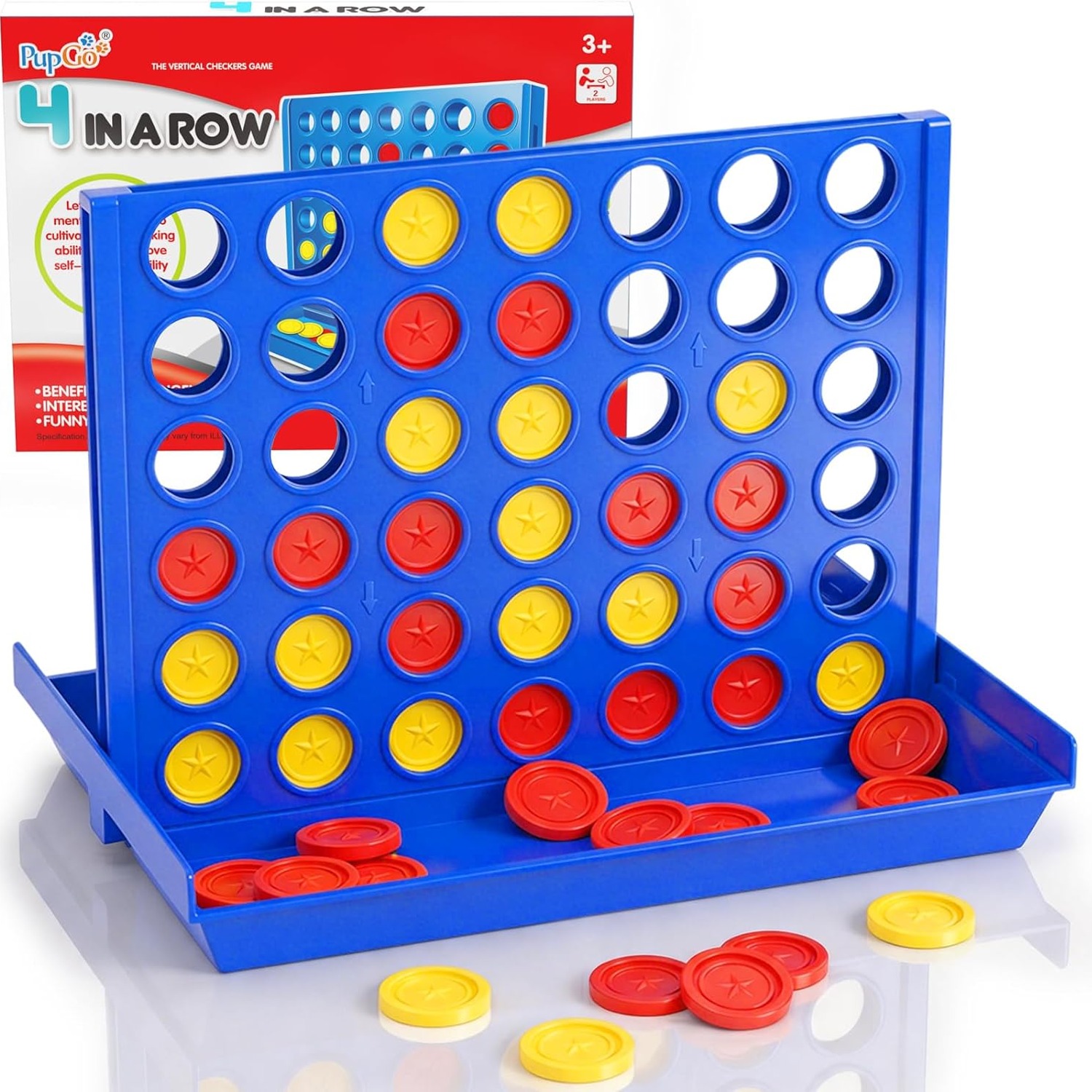
Included Components1 grid with tray, 42 discs plus 6 spare discs
Number of Items48
Number of Players2
Age Range3 years and up
MaterialPlastic
Item TypeLine game
GenreEducational, entertainment, maths, party, strategy
Educational ObjectiveBuilds STEM skills, logical thinking and problem solving
Assembly RequiredNo
Operation ModeManual
Indoor or OutdoorIndoor
Special FeaturePortable
Container TypeBox
Package Quantity1
EditionStandard
Item Dimensions25 x 19 x 0.1 cm
Shipping Weight0.26 kg
Weight0.26 kg
Shipping & returns

Tracked delivery anywhere in New Zealand. It is free on orders of $175 or more, and a flat $20 below that.

If it is not right for you, send it back within 14 days of delivery in resaleable condition and we refund the price you paid, including standard delivery. That is a voluntary policy we offer on top of your legal rights. You cover the cost of returning it unless the item is faulty.

If it arrives faulty, damaged or not as described, we put it right at no cost to you under the Consumer Guarantees Act 1993 and the Fair Trading Act 1986, return postage included.

Shipping details · Refunds and returns

Rules In SecondsDrop a disc, make a line of four, win the round.
48 Discs Included42 playing counters plus 6 spares in case one wanders off.
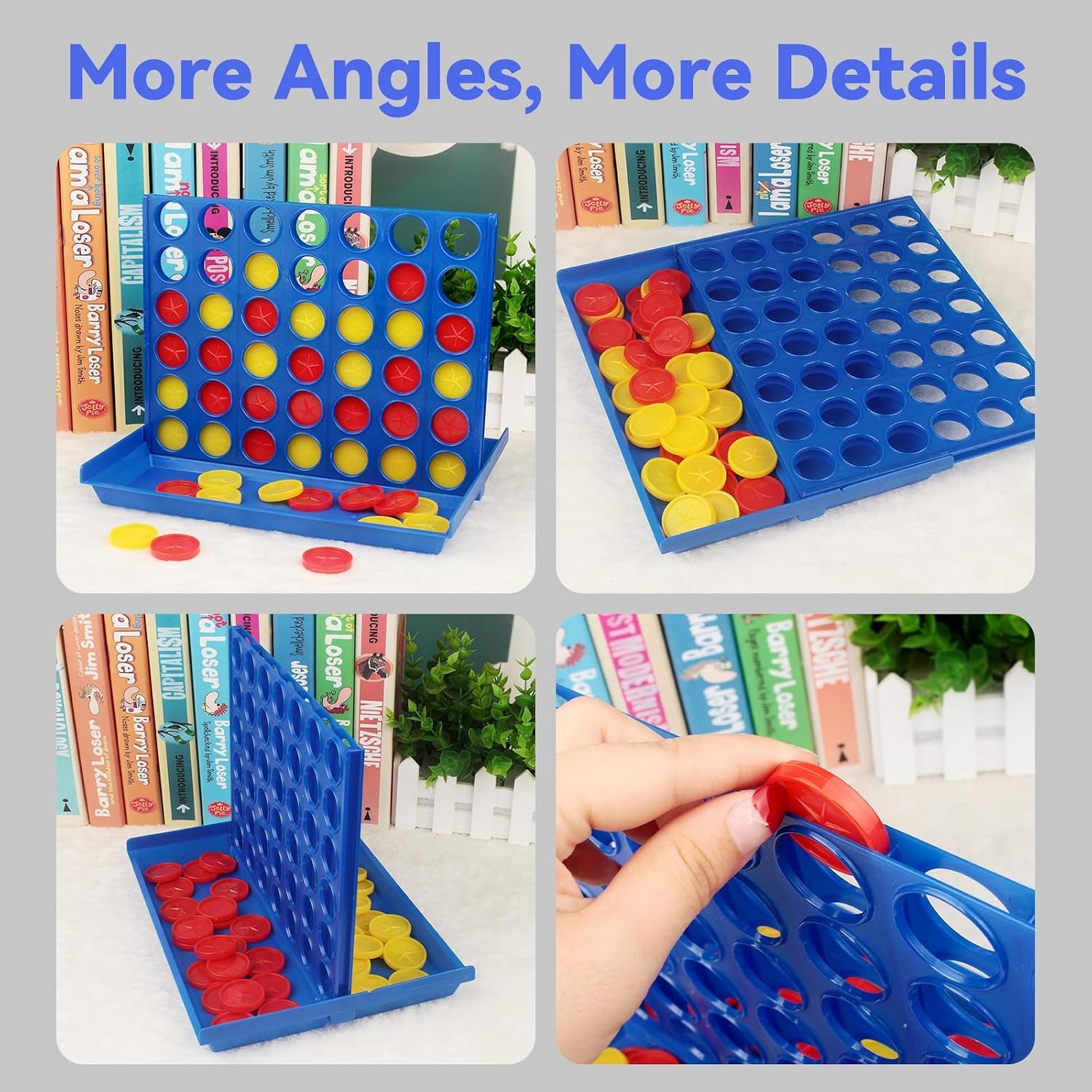
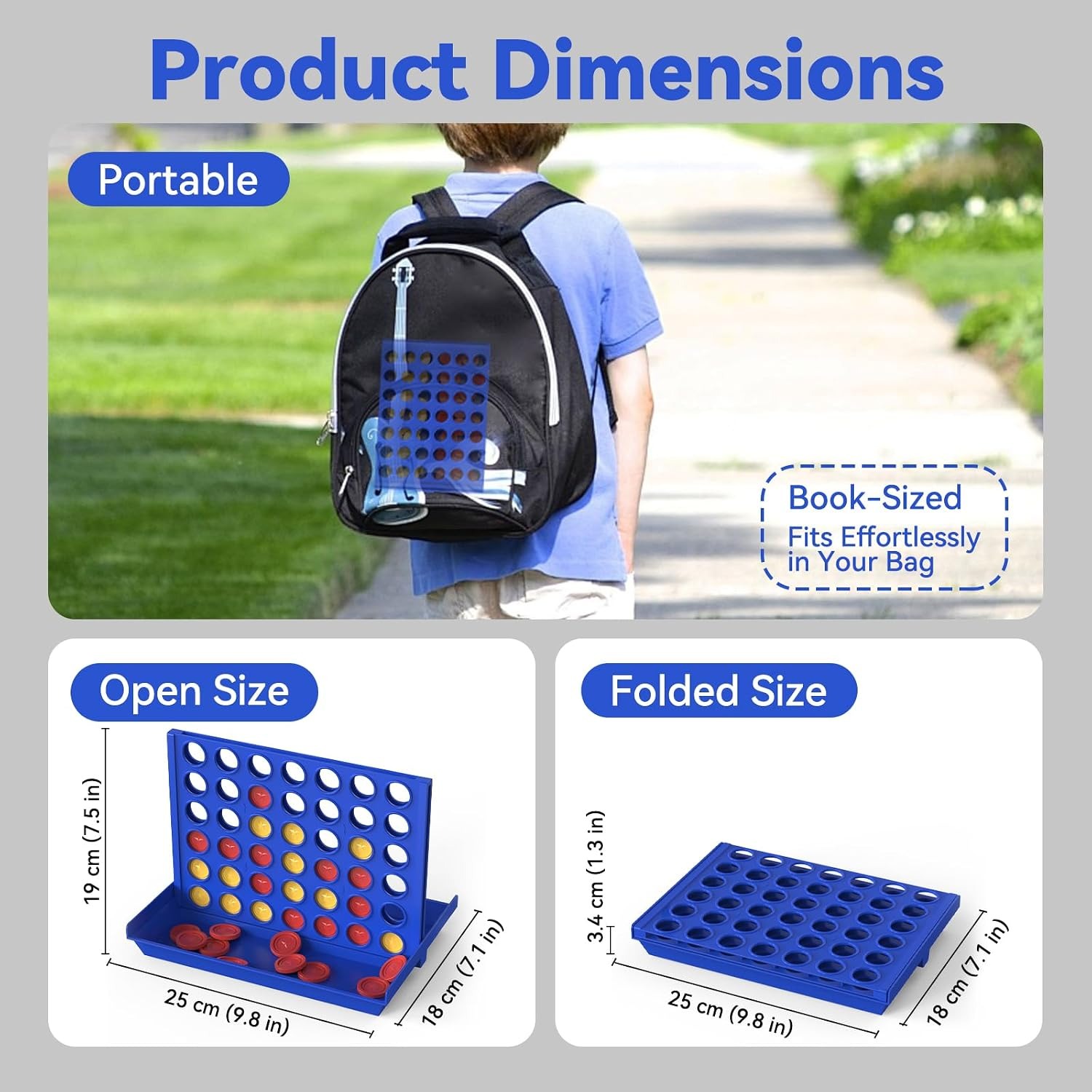
Packs Up FlatA slim 25 x 19 cm grid that slides into a bag for trips.
Quiet Thinking PracticePlanning ahead and spotting patterns, disguised as a game.

A four in a row game that gets two people laughing, thinking and playing within about thirty seconds of opening the box.

A stand-up grid with a catch tray, 42 coloured discs plus 6 spares, and rules simple enough for a three-year-old but sneaky enough to keep adults hooked.

A classic line up four game where two players take turns dropping discs into a standing grid and race to build a row of four.

The board stands on its own and sits in a catch tray, so finished rounds reset with one slide instead of a scramble across the table.

Forty-two coloured discs come in the box along with six spares, which takes the sting out of the one piece that always disappears.

Rated by the manufacturer for ages 3 and up, so a parent and a preschooler can play the same game a teenager will happily rematch.

At 25 x 19 cm and 0.26 kg it packs flat for holidays, waiting rooms, camping and the back of a car.

4 in a Row Connect Board Game

Some games need a rules booklet, a setup phase and a patient adult to referee. This is not one of them. You stand the grid up, split the discs by colour, and the first round starts about ten seconds later. One player drops a disc into a column, the other answers, and the first to make four in a line (across, up and down, or on the diagonal) takes the round. That is the whole thing, and it is why a four in a row game has survived decades of flashier competition.

4 in a Row Connect Board Game

The build is straightforward plastic, with a stand-up grid that sits in its own catch tray. That tray matters more than it sounds. When a round ends you release the discs and they land in the tray instead of bouncing off the table and under the sofa. Reset takes a few seconds, which is exactly how long a rematch request lasts before someone loses interest.

4 in a Row Connect Board Game

Inside the box you get 42 playing discs plus 6 spares, 48 pieces in total. Most sets ship the bare minimum, so the extras are a genuinely useful touch. A game like this lives or dies on having a complete set of counters, and the spares buy you a few years of grace against vacuum cleaners, car seats and small hands.

4 in a Row Connect Board Game

The manufacturer rates it for 3 years and up, and that lower end is honest if an adult plays along. A three-year-old will mostly enjoy dropping discs and watching them stack, which is still good practice at taking turns and matching colours. By five or six, children start blocking on purpose. By eight, they start setting traps, and that is when parents begin to lose.

4 in a Row Connect Board Game

Listed as a strategy and educational game, it quietly works on pattern recognition, forward planning and the habit of thinking one move ahead before committing. None of that is announced during play. It just happens, round after round, while two people stare at a grid and argue about whether the last move was lucky or clever.

Not sure yet? That is fine.

A toy has to suit the child it is for, and you cannot always judge that from a photograph. If it is not right for you, send it back within 14 days of delivery in resaleable condition and we refund the price you paid, including standard delivery. That is a voluntary policy we offer on top of your legal rights.

If it turns up faulty, damaged or not as described, that is on us. The Consumer Guarantees Act 1993 and the Fair Trading Act 1986 covers you, and we pay the return postage. Read the full detail on our refunds and returns page, or ask us anything before you order.

Frequently Asked Questions

What is a four in a row game?

It is a two-player game where each person drops coloured discs into a standing grid, taking turns. The first player to line up four of their own discs in a row, column or diagonal wins the round. It is one of the easiest strategy games to teach and one of the hardest to master.

How many players can play at once?

The game is designed for 2 players. You can still run it with a group by playing a winner-stays-on ladder, which works well at parties and in classrooms. Two people play each round while others watch and plan their turn.

What age is this suitable for?

The manufacturer recommends 3 years and up. Younger children usually need an adult playing along, and will enjoy the stacking and colour matching before they grasp the strategy. By around five or six, most children start blocking and planning on their own.

What is in the box?

You get one grid with a catch tray, 42 playing discs and 6 spare discs, which is 48 pieces in total. The package quantity is 1 set. No batteries or extra parts are needed.

Why does it come with spare discs?

Because discs go missing. A standard set needs 42 counters to play a full board, so losing even one or two is annoying. The 6 extras mean a stray piece under the car seat does not end the game.

What is the board made of?

The listing states the material as plastic. Detailed finish information beyond that is not specified by the maker.

How big is the game?

The item dimensions are 25 x 19 x 0.1 cm. It is a standard-size grid rather than a mini travel version, so the discs are easy to grip while the whole thing still packs flat.

How heavy is it?

It ships at 0.26 kg. That is light enough to throw in a day bag or suitcase without thinking about it, which is part of why it works as one of the best travel board games for families.

Does it need assembly?

No. The listing confirms no assembly is required. Stand the grid up, sort the discs by colour and you are playing.

Does it need batteries?

No. The operation mode is manual, so there is nothing to charge, replace or switch on. That also means it works on a plane, in a tent or during a power cut.

How long does a round take?

Most rounds run a few minutes, often less once both players know what they are doing. That short format is the appeal, since you can fit several games into a car trip or a lunch break.

How do you reset between rounds?

The grid sits in a catch tray, so you release the discs and they drop into the tray rather than scattering. Sort them back into two colour piles and you are ready again in seconds.

Is this good for a classroom?

Yes, it is listed as suitable for home and classroom use. Teachers often use a line up four game for indoor recess, early finishers or quiet thinking time. It is quiet, self-explanatory and needs no supervision once the rules are shown.

What skills does it teach?

The educational objective listed is STEM skills, logical thinking and problem solving. In practice children learn to look for patterns, plan a move ahead and spot when an opponent is one disc away from winning. It is one of the best educational board games precisely because none of that feels like work.

Can adults enjoy it too?

Absolutely. The game has a deceptive amount of depth once both players start setting double threats. Plenty of adults rediscover it and then refuse to stop until they win.

Is it suitable for outdoor play?

The listing marks indoor and outdoor usage as indoor, so treat it as an indoor game. If you do take it outside, keep it on a flat, dry surface and out of strong sun, since plastic can warp with heat.

Can it be used while travelling?

Yes, it is described as portable and the slim profile packs flat. It is a solid pick as a best quick play board game for road trips, flights, holiday rentals and camping, as long as you keep the discs in the tray.

Is it safe for young children?

Discs are small, so children under three should not play unsupervised due to the choking risk. The recommended age is 3 years and up. Always keep an eye on preschoolers around any game with small loose pieces.

How do you win a game?

Make a straight line of four of your own discs. The line can run horizontally, vertically or diagonally. If the grid fills with no line of four, the round is a draw and you reset.

Is there a first-move advantage?

In this style of game, going first does help, so most players alternate who starts each round. It keeps things fair and stops one player collecting easy wins.

What colours are the discs?

The listing describes the colour as standard and does not specify exact disc shades in the maker's details. Sets of this type use two contrasting colours so players can tell their pieces apart at a glance.

How do I clean it?

Wipe the grid and discs with a slightly damp cloth, then dry them before putting the set away. Avoid soaking the pieces or running them through a dishwasher. Sticky fingers come off easily with plain water.

How should I store it?

Count the discs back into the tray and keep the set in its box. Storing it flat stops the grid from bending. A shelf or games drawer away from heat is ideal.

Will it last with heavy use?

The pieces and grid are plastic and built for repeated play, with the spare discs covering the usual losses. Like any game, longevity comes down to storing it properly and not standing on it.

Is it a good gift?

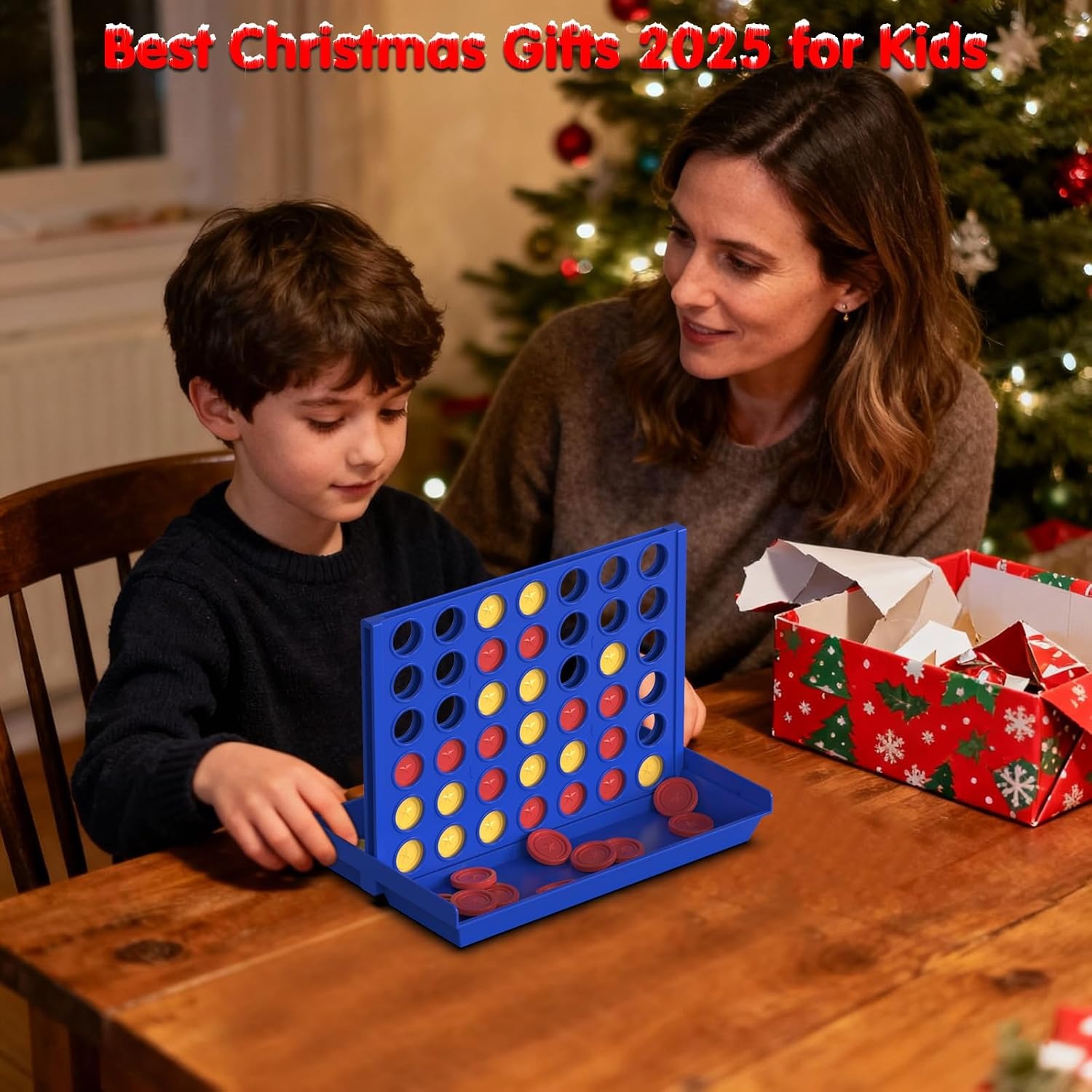
It is one of the best gift board games for a child between about four and twelve, and it suits birthdays, Christmas and end-of-term presents. It is also an easy grandparent-and-grandchild game, since the rules need no explaining twice.

Can two children play without an adult?

Once they understand the rules, yes. Most children aged five and up can run their own rounds, settle their own results and reset the board. Supervise younger players because of the small discs.

Does this work for children who find board games frustrating?

Often yes, because rounds are short and a loss is over quickly. There is no long setup to waste and no complicated scoring to argue about. The immediate rematch is usually enough to keep things cheerful.

What is the brand and model?

It is the Pup Go 4 in a Row Connect Board Game, model number NO.17819, with the manufacturer listed as SHUANGDI. The UPC is 661748839859.

How is it delivered and can I return it?

It ships from our fulfilment partner and arrives in its retail box. If you need to send it back, contact us with your order number and we will walk you through the return steps. Keep the packaging until you are sure you are keeping it.

What if it is not right for us?

Get in touch within the returns window with your order number and tell us what the problem is. If the set arrives damaged, has pieces missing or simply is not what you expected, we will sort out a replacement or a refund. We would rather fix it than have a game sitting unused in a cupboard.

Choosing a Four in a Row Game That Actually Gets Played

6 min read Toy Warehouse

The problem with most games in the cupboard

Walk past any family's games shelf and you will find the same thing. Three or four big boxes, each with a rulebook nobody has read since the first attempt, a bag of pieces that may or may not be complete, and a thin layer of dust. They get played twice a year, usually at Christmas, usually with an argument.

The games that actually get played are the small ones. The ones you can set up in under a minute, finish in five, and reset without a discussion. A four in a row game sits right in that sweet spot. Two players, one grid, a pile of discs, and a rule you can explain in a single sentence to a five-year-old.

That low barrier is the whole trick. If a game takes ten minutes to set up, somebody will decide it is not worth it. If it takes ten seconds, it gets played on a Tuesday after dinner for no reason at all.

How this one works

The grid stands upright on the table and sits inside a catch tray. Each player takes a colour and the discs are split between them. You take turns dropping a disc into any column you like. Gravity does the rest, and the disc settles on top of whatever is already in that column.

Your goal is four of your discs in a straight line. Across, up and down, or diagonally. First to make the line wins the round. If the whole grid fills with nobody making four, it is a draw and you start again.

What makes it interesting is that you cannot place a disc wherever you want. You can only choose the column, not the height. So you spend the game shaping the stack, forcing your opponent to fill a square you want, and watching for the moment they leave a gap. Good players learn to set up two threats at once, because the other person can only block one of them.

That is the entire depth of the game, and it is more than enough. People have been losing their tempers over it for decades.

What you get in this set

This set includes one grid with the tray, 42 playing discs and 6 spares, which comes to 48 pieces in total. The 42 is the number you need for a full board. The six extras are the useful part, because a set of this kind eventually loses a disc or two to the floor, the car or a preschooler's pocket.

The board measures 25 x 19 x 0.1 cm and the item ships at 0.26 kg. That is standard size rather than a shrunken travel edition, so the discs are big enough for small fingers and for adults who do not want to fumble. It still packs flat enough for a backpack.

No assembly is required and there are no batteries. The operation mode is manual, which is a technical way of saying it is a board and some discs. Nothing to charge, nothing to update, nothing to break.

The material is listed as plastic. The manufacturer is SHUANGDI and the model number is NO.17819.

Who it suits

The recommended age is 3 years and up, and that lower figure is realistic as long as an adult is playing too. A three-year-old is not planning diagonals. They are dropping discs, watching them stack, taking turns and matching colours, all of which are genuinely useful things to practise. The win condition can wait.

Around four or five, children start noticing when they have three in a row. Around six, they start noticing when you do, and blocking you on purpose. Somewhere around eight or nine, they work out the double threat and you stop winning by default. That progression is one of the nicer things about this kind of game, because the same box keeps working as a child grows.

For adults it is a quick two-player filler. For a classroom it is a quiet, self-running activity. One of the best classroom games is simply a game a teacher does not have to supervise, and this qualifies. Set up a winner-stays-on ladder and a group of eight can rotate through it happily.

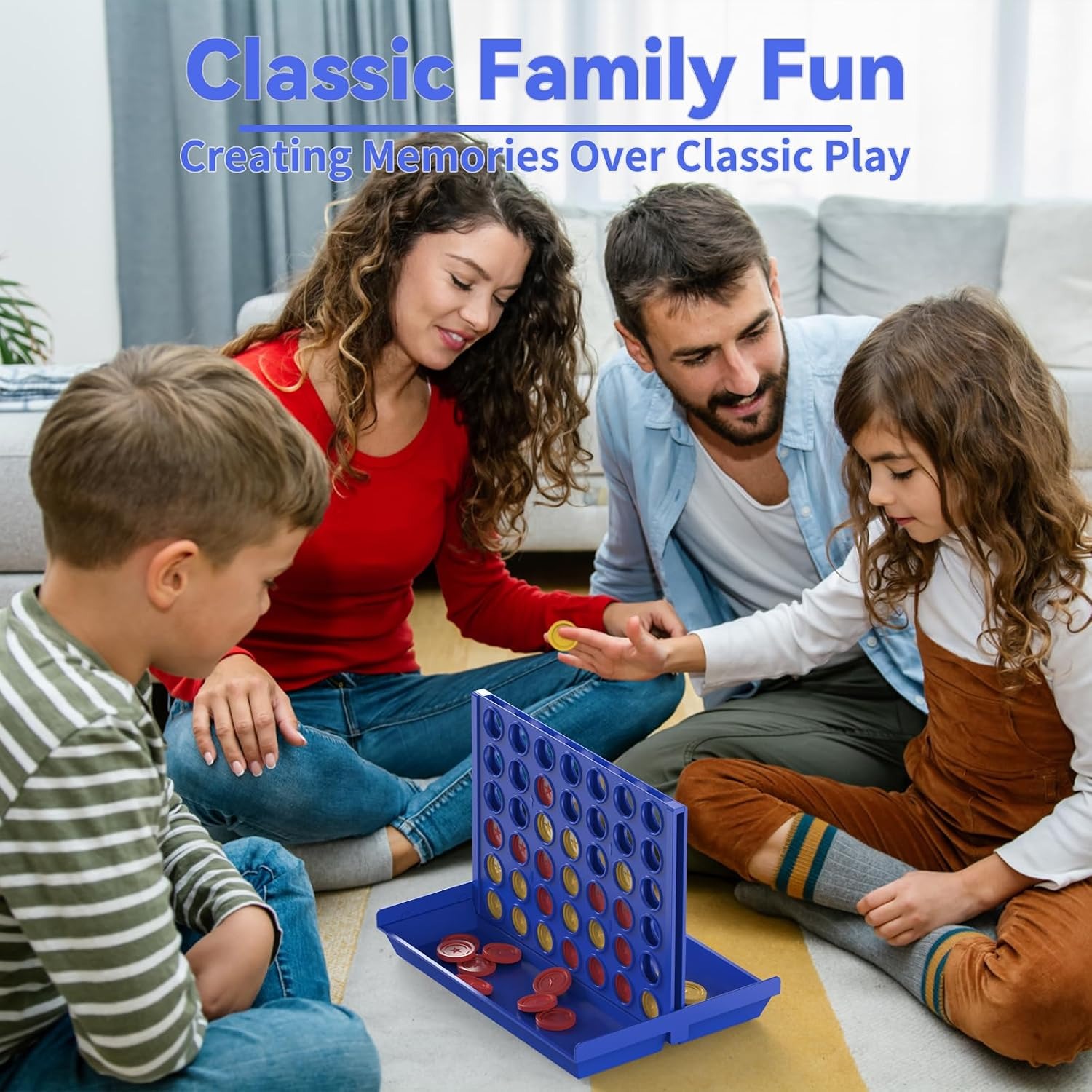
It also works well across generations. A grandparent who has not played a board game in thirty years does not need the rules explained. They already know them.

Where it fits in your life

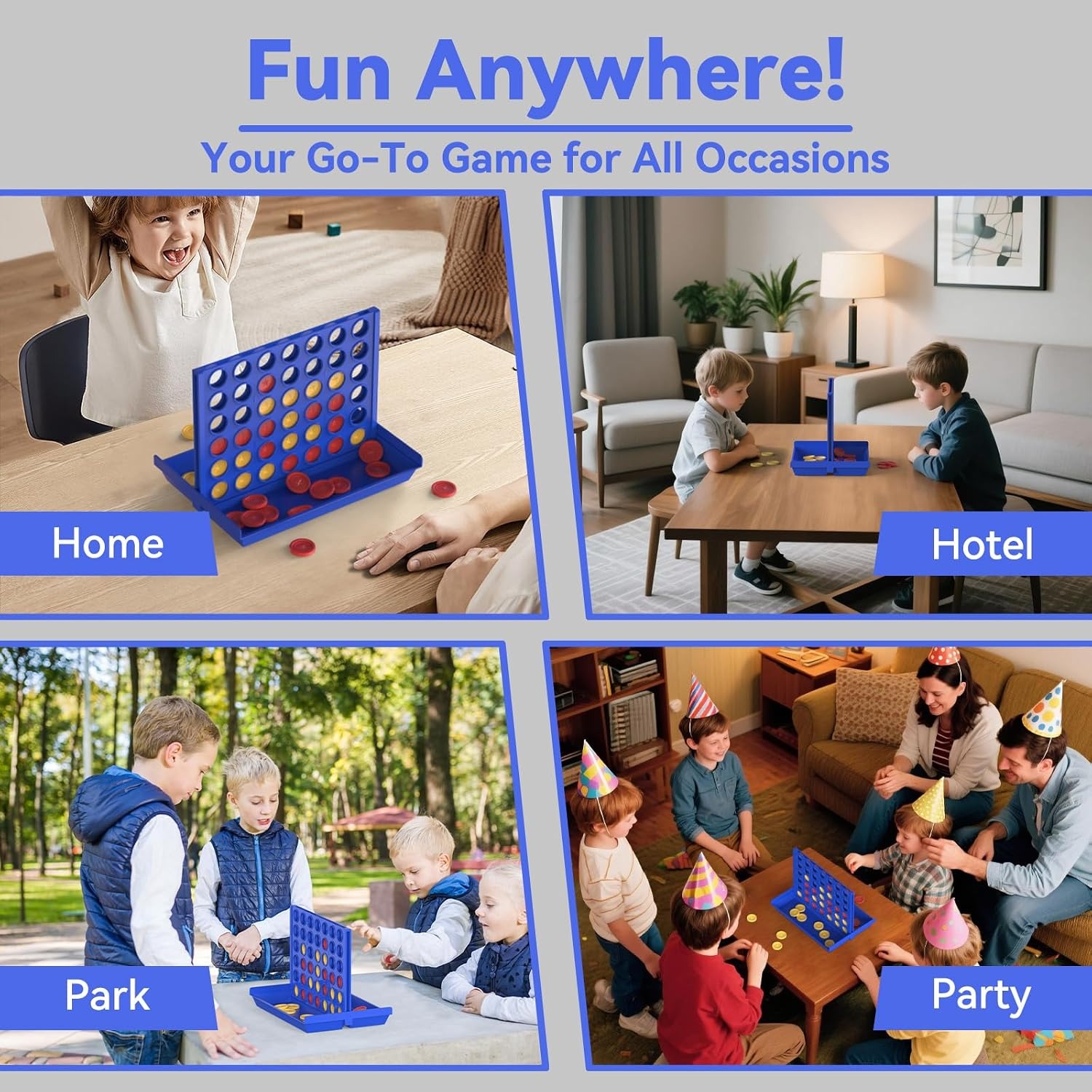
This set is listed for indoor use, so the kitchen table, the lounge floor, the classroom and the holiday rental are its natural homes. It is also described as portable, which is the point of the flat profile.

A game like this earns its keep in the gaps. Waiting for dinner. A long train journey. The hour before bed when screens have been switched off and nobody has a better idea. Twenty minutes in a waiting room with a bored child is transformed by something that takes seconds to start.

If you are packing for a trip, this is the sort of thing that goes in without debate because it weighs almost nothing. A good travel game is one you forget you packed until the moment you need it.

How to choose between sets

Not all four in a row sets are equal, and the differences are easy to miss online.

Size is the first thing. Mini travel versions are tempting because they are tiny, but the discs can be fiddly for young children and the grid can tip over on a soft surface. A standard-size board like this one is a better all-rounder if you only want one set.

Second, check the disc count. Forty-two is the full complement for a standard grid. Anything less and you cannot fill the board. Spares are a bonus, not a given, and they matter more than people expect.

Third, look for a catch tray. Without one, every finished round ends with discs rolling off the table. With one, the reset is a single motion. It sounds trivial until you have played six rounds in a row with a seven-year-old.

Fourth, think about who is actually playing. If it is mostly a two-player household game, go for something that stores flat and is quick to get out. If it is going into a classroom, prioritise sturdiness and a complete piece count over looks.

Looking after it

Care is simple. Wipe the grid and the discs with a damp cloth when they get sticky, then dry them before putting the set away. Do not soak the pieces and do not put them in a dishwasher, because heat and plastic are a poor combination.

Store the set flat in its box, away from radiators and strong sunlight. A thin plastic grid can warp if it sits in a hot car for a week.

The single most useful habit is counting the discs back into the tray after each session. It takes fifteen seconds and it is the difference between a game that works for five years and a game that becomes a half-set nobody can play.

The short version

A four in a row game is one of the few board games that genuinely gets used. The rules take one sentence, a round takes a few minutes, and the strategy runs deeper than it looks.

This set gives you a stand-up grid with a catch tray, 42 discs and 6 spares, at 25 x 19 x 0.1 cm and 0.26 kg. It needs no assembly, no batteries and no explaining. The recommended age is 3 and up, and it stays interesting long past that.

If you want one game that a preschooler, a nine-year-old and a sceptical adult will all play without complaint, this is a sensible choice. Keep it somewhere easy to reach. That is really the only requirement.

Browse the shop

Ready for a rematch?

Add the four in a row game to your cart and have a two-minute game night waiting in the drawer.

Ask us a question

Page summary

The Pup Go 4 in a Row Connect Board Game (model NO.17819, UPC 661748839859) is a two-player line-up-four strategy game made of plastic. It includes one stand-up grid with a catch tray, 42 coloured discs and 6 spare discs, for 48 pieces total. The board measures 25 x 19 x 0.1 cm and the item ships at 0.26 kg. The manufacturer recommends ages 3 years and up, lists the manufacturer as SHUANGDI, and the country of publication as China. No assembly is required and play is manual. It is listed for indoor use and described as portable, with educational aims covering STEM skills, logical thinking and problem solving. Colour, material finish detail and country of origin are not specified by the maker.