
The complete guide
How To Choose A Wooden Puzzle Set For A Three To Five Year Old
The problem most parents are actually trying to solve
It usually starts the same way. You want something your child will sit down with for twenty minutes that does not involve a screen, does not need batteries and does not create a mess you have to clean up afterwards. Blocks get scattered. Paint gets everywhere. The tablet is easy but it leaves everyone a bit flat.
Puzzles land in a useful spot. They have a clear beginning and a clear end, which young children like. They can be done sitting still at a table, which suits a tired afternoon. And when the last piece goes in, there is a real moment of satisfaction that a child earned on their own.
The catch is that a lot of puzzles sold for this age group are not built for it. Thin cardboard pieces curl after a few sessions. Piece counts jump from eight to sixty with nothing sensible in between. Pictures are busy to the point where a child cannot tell one bit of sky from another. A wooden puzzle set aimed squarely at three to five year olds fixes most of that.
What makes a wooden puzzle different
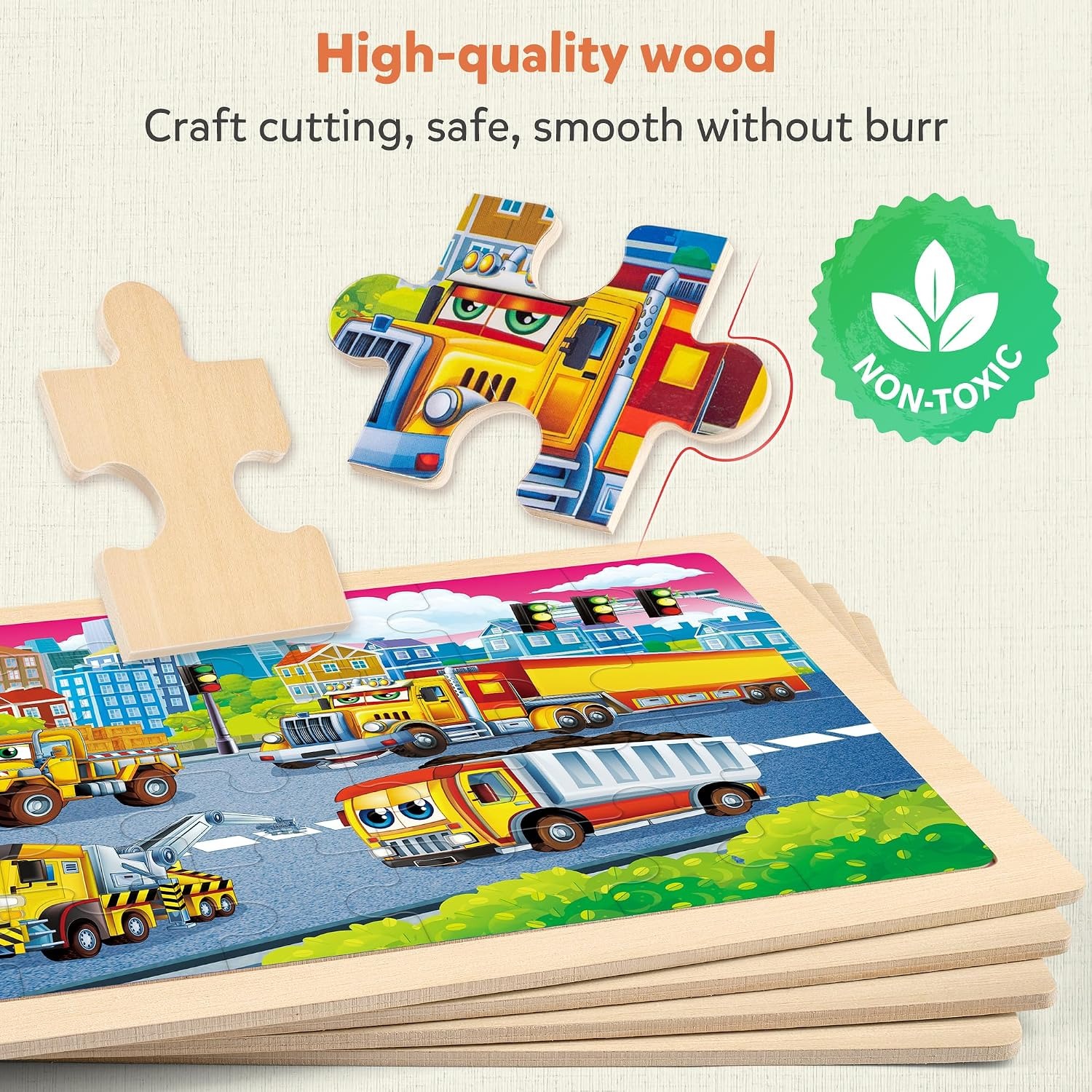
Pick up a wooden jigsaw piece and you can feel the difference straight away. It has weight. It keeps its shape. The tabs that hold neighbouring pieces together do not soften and flatten the way cardboard tabs do after being pulled apart twenty times.
That matters more than it sounds, because puzzles at this age are not done once. A four year old who likes a picture will do it again and again, sometimes three times in an hour. A cardboard puzzle that survives a single week of that is doing well. Wood simply holds up.
The second difference is grip. Small fingers are still learning fine motor control. A piece with some thickness to it can be pinched, lifted and rotated without buckling. A thin piece slips, bends and lands face down, and that small failure repeated ten times is what makes a child push the whole thing away.
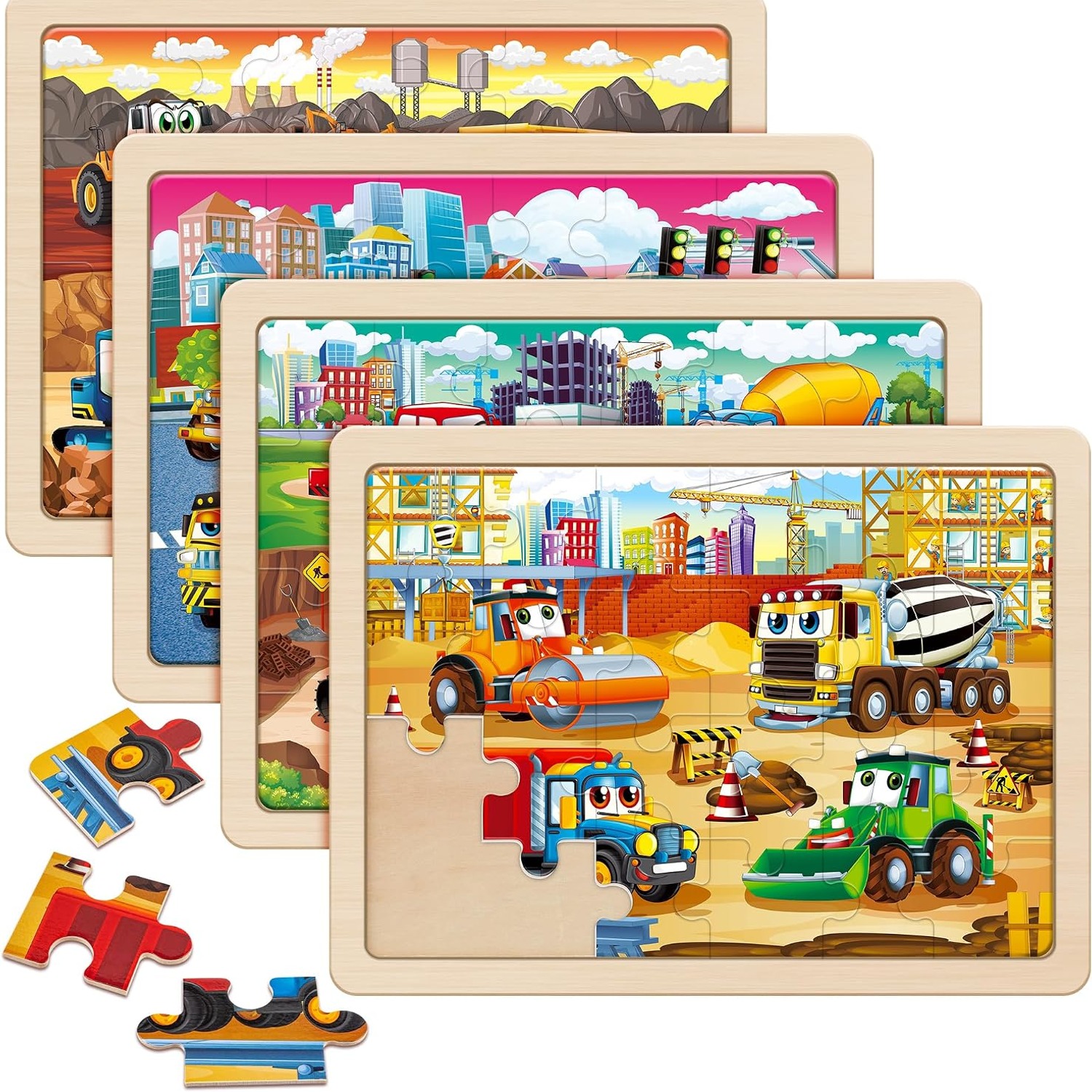
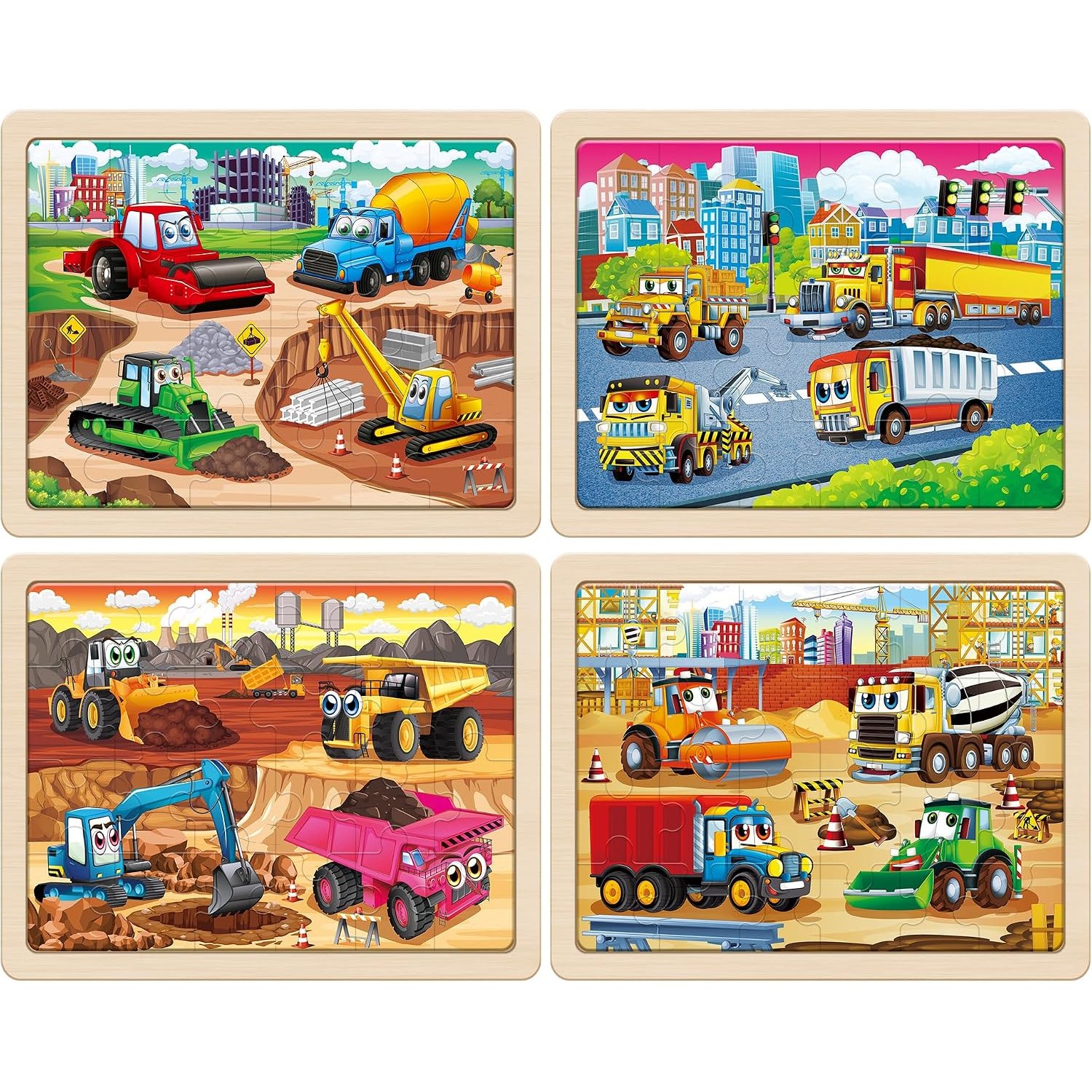
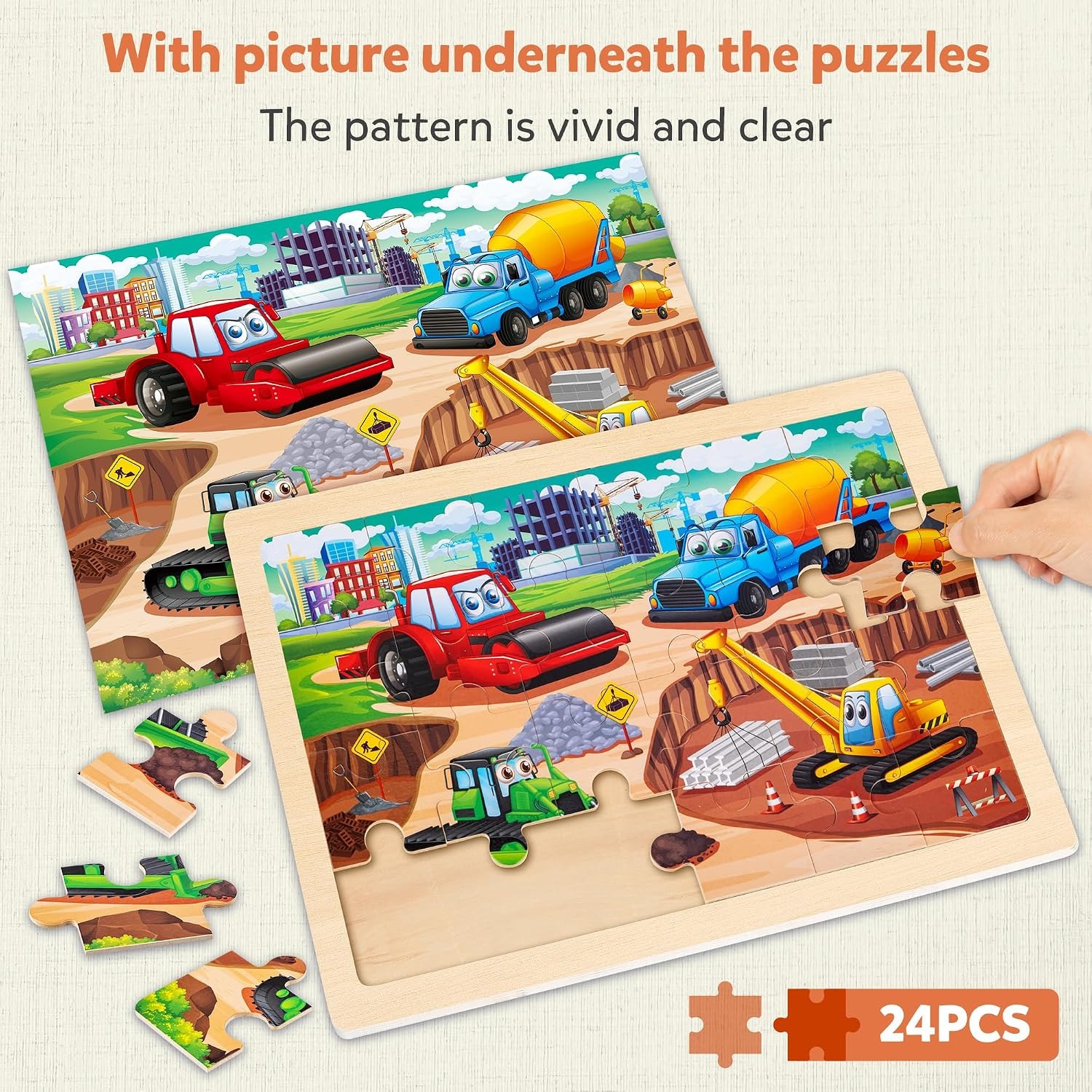
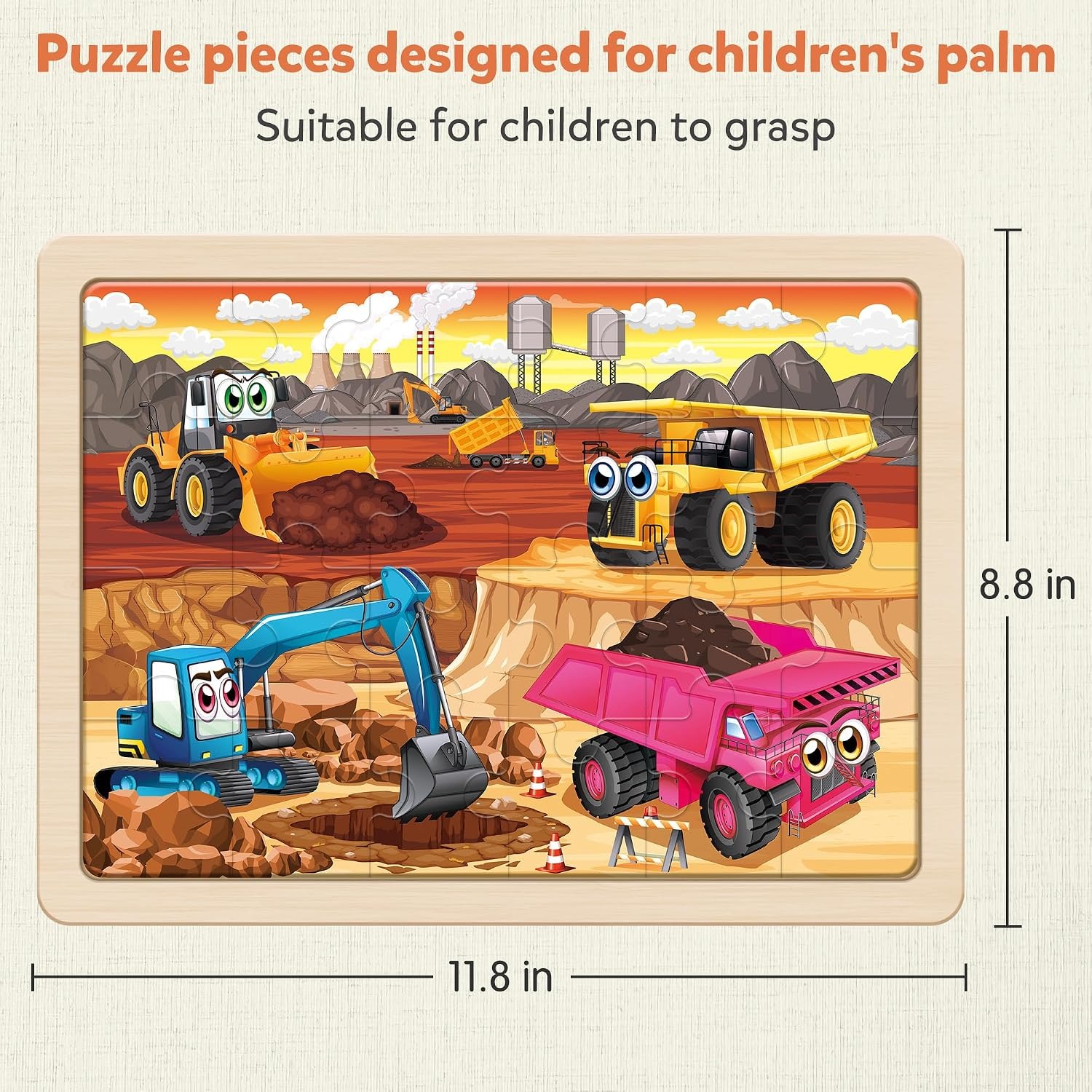
This particular set is made of wood with four puzzles at 24 pieces each, which adds up to 96 pieces in the box. Each piece is finished smoothly so the edges are comfortable to handle.
Why the frame earns its keep
The wooden frame around each puzzle is the detail parents tend to appreciate most after a week of use.
A frame does three things. It gives the child a defined edge to build toward, which is the single most useful strategy in jigsaw solving. It stops completed sections from sliding apart when the table gets bumped. And it keeps the loose pieces corralled in one area instead of migrating across the floor.
There is also a guide underneath. A removable paper illustration sits below each puzzle showing the completed picture. When a child gets stuck, they can lift it, look, and get themselves unstuck without an adult stepping in. That small bit of independence is worth a lot, because the goal is a child who solves a problem rather than a child who asks for the answer.
Matching the puzzle to the child
The manufacturer recommends ages 36 months to five years, with a beginner skill level. That is a wide band and children move through it at very different speeds, so it helps to think about where yours sits right now.
A child who has never done a jigsaw will likely need company for the first few goes. Sit beside them, sort the pieces into a loose pile, and hand them over one at a time. Talk about what they see. "This one has a yellow wheel, where else is there yellow?" You are teaching a method, not just finishing a picture.
A child who has done chunky four-piece or six-piece puzzles is ready for a 24-piece jump with support. Start with the frame edges, then fill the middle.
A confident four or five year old will often take over completely. At that point the job changes from helping to staying out of the way. Let them struggle for a minute before offering anything, because the struggle is where the learning sits.
If a puzzle is finished too fast and interest drops, try turning all the pieces face down and flipping them one at a time, or time them and see if they can beat their own record. Same puzzle, new challenge.
Why construction vehicles hold attention
Theme matters more than people expect. A child who stops the pram to watch an excavator at the end of the street will give a digger puzzle far more patience than a generic farm scene.
This set runs on construction and building scenes across its four puzzles, so there is variety rather than four versions of the same truck. Different vehicles, different worksites, different colour palettes. That variety is what gets you through a wet school holiday instead of one afternoon.
It also opens up conversation. Naming the machines, talking about what each one does, asking which one they would drive. The puzzle becomes a starting point rather than a silent task, and that is where a lot of the language learning quietly happens.
What the puzzle is actually teaching
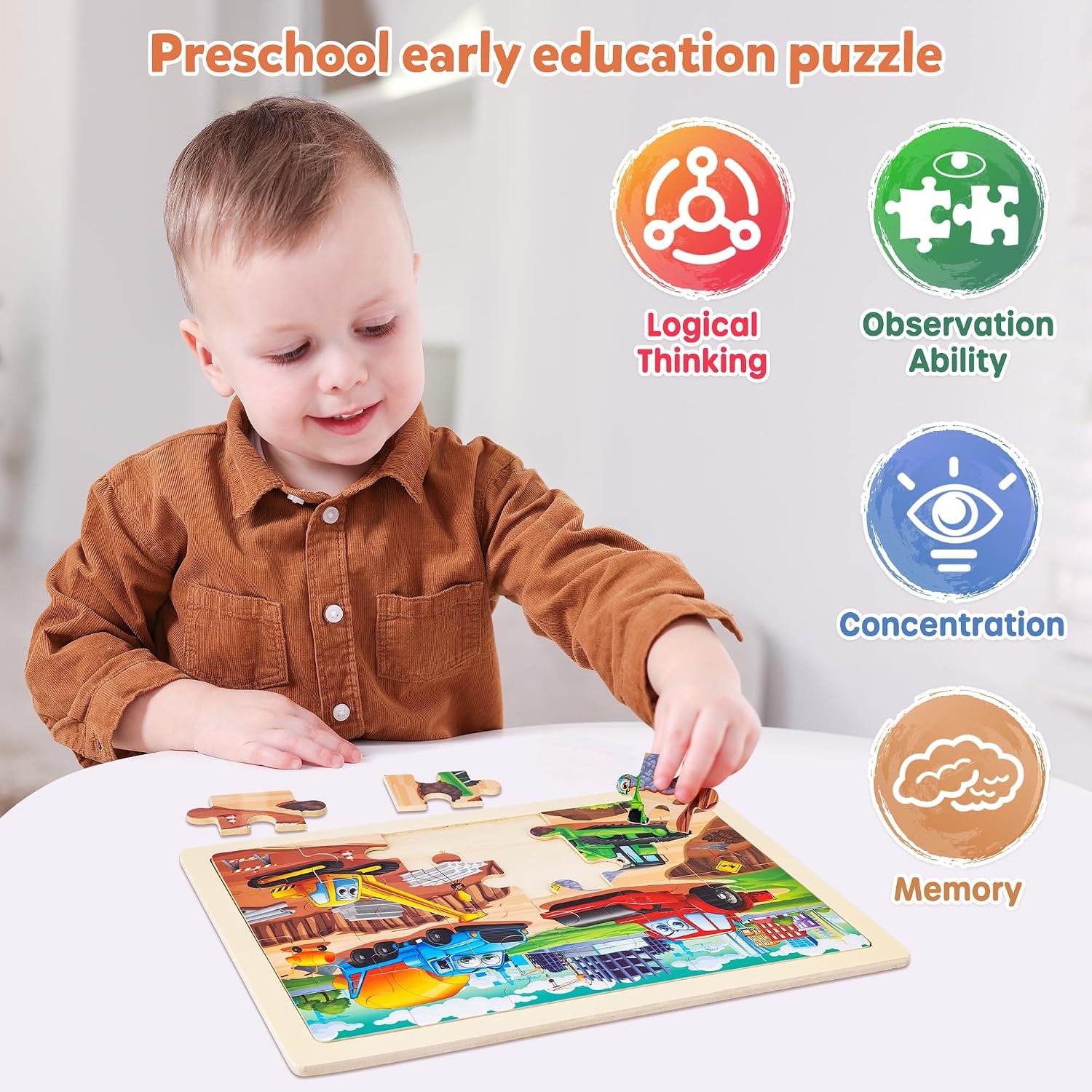
The listed educational aims are logical thinking, problem solving and spatial awareness. Those sound formal, so here is what they look like at a kitchen table.
Spatial awareness is a child holding a piece, looking at a gap, and deciding whether it will fit before they try. That is mental rotation, and it is a skill that shows up later in maths and reading maps.
Problem solving is what happens when the piece does not fit. Do they force it, give up, or try the next gap along? Over a few weeks you will see them move from forcing to testing.
Logical thinking is sorting. Edge pieces first, then colour groups, then shapes. Nobody has to teach this explicitly. Children work it out through repetition, and a 24-piece puzzle is small enough that the pattern becomes obvious.
Fine motor control comes along for the ride. Every pinch, lift and press is practice for holding a pencil.
Practical care and storage
Wood needs very little looking after, but it does not like water. Wipe pieces with a slightly damp cloth and dry them right away. Never soak them and never put them anywhere near a dishwasher, because moisture swells wood and can lift printed artwork.
Keep the set out of direct sunlight for long stretches, since strong sun fades printed colour over time. Store it flat in its box so nothing warps.
The best habit, honestly, is counting pieces back into each frame when play finishes. A 24-piece puzzle with 23 pieces is a disappointment waiting to happen, and two minutes of tidying prevents it.
Buying it as a gift
At 0.72 kg and boxed, this is an easy gift to hand over. No assembly, no batteries, no setup. It suits birthdays, Christmas and the general category of "their parents will thank me."
The four-puzzle format gives it extra life as a present. A single toy is opened and done. Four separate puzzles can be rationed across a holiday week, or split between siblings so two children can work side by side.
If you are buying for a child you do not see often and you are unsure of their puzzle experience, a beginner-level set in this age band is a safer bet than something harder. A puzzle that is slightly too easy gets played with. One that is too hard gets abandoned.
The short version
If you want a screen-free activity for a three to five year old that will survive being used over and over, a wooden puzzle set is a solid buy. This one gives you four 24-piece construction vehicle puzzles, each in its own frame, each with a picture guide underneath. The pieces are wood, finished smoothly, and sized for small hands.
It is light enough to travel, simple enough to need no setup, and built around a theme plenty of children at this age are already fascinated by. For first-time puzzlers it offers support through the frame and guide. For children who have outgrown four-piece boards it offers a step up that still feels achievable.
Set it on a table, sit down for the first few minutes, and then let them get on with it.