

The complete guide
How To Choose A Wooden Farm Train Set That Actually Gets Played With
The toy that gets used twice and then disappears
Every household has one. A toy that looked brilliant in the photo, got a loud reaction on the day, and then slid under a bed by the end of the month. With train sets it usually happens for the same reason. The child builds the loop, pushes the train around it, and then runs out of things to do. There is no reason for the train to go anywhere, so it stops going anywhere.
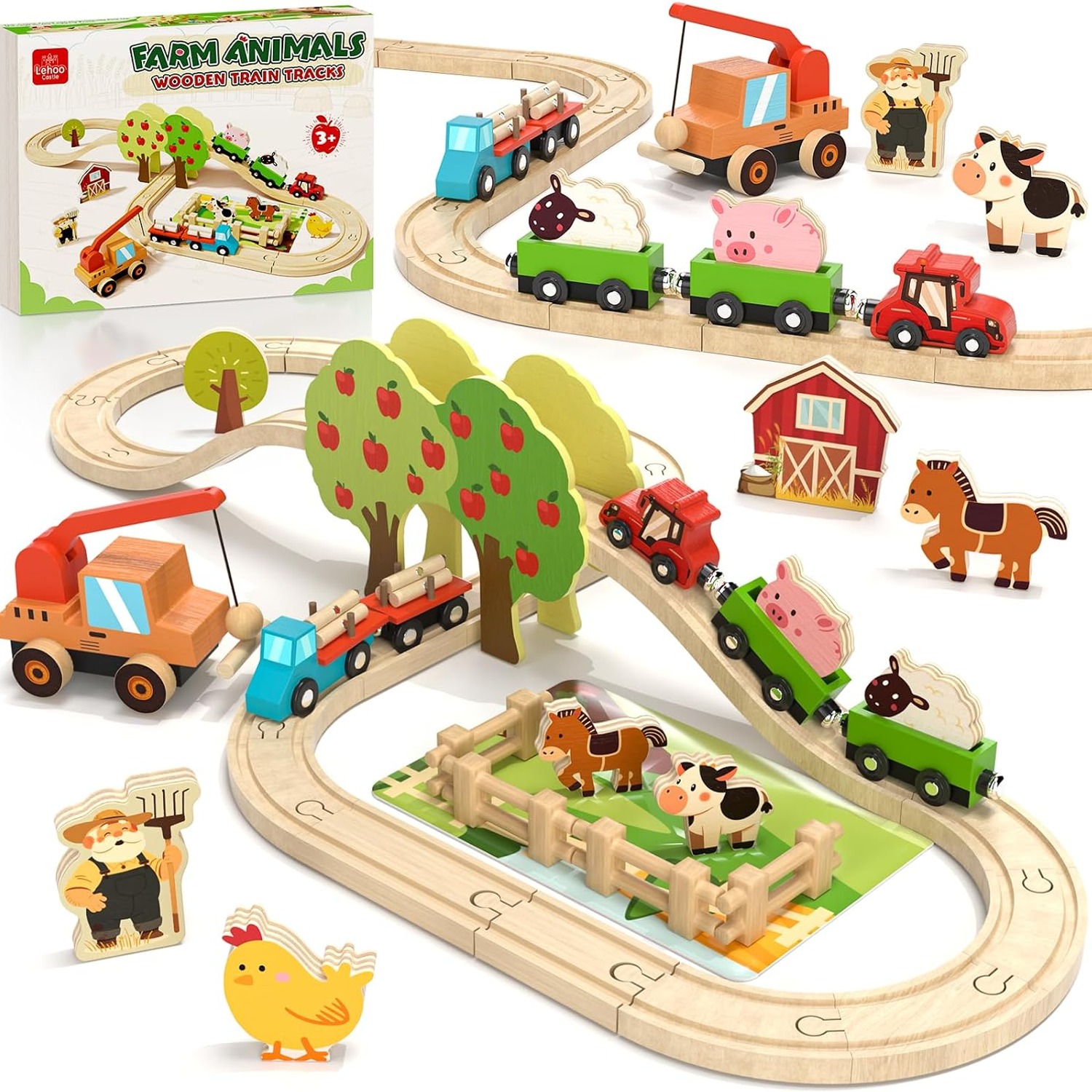
The fix is not more track. It is giving the train somewhere to arrive. That is the whole idea behind a wooden farm train set. Once there are cows to move, a barn to fill and a crane to work, laying the track becomes the setup rather than the whole game. A child who has a reason to run the train will run it for an hour, then come back to it the next day with a new plan.
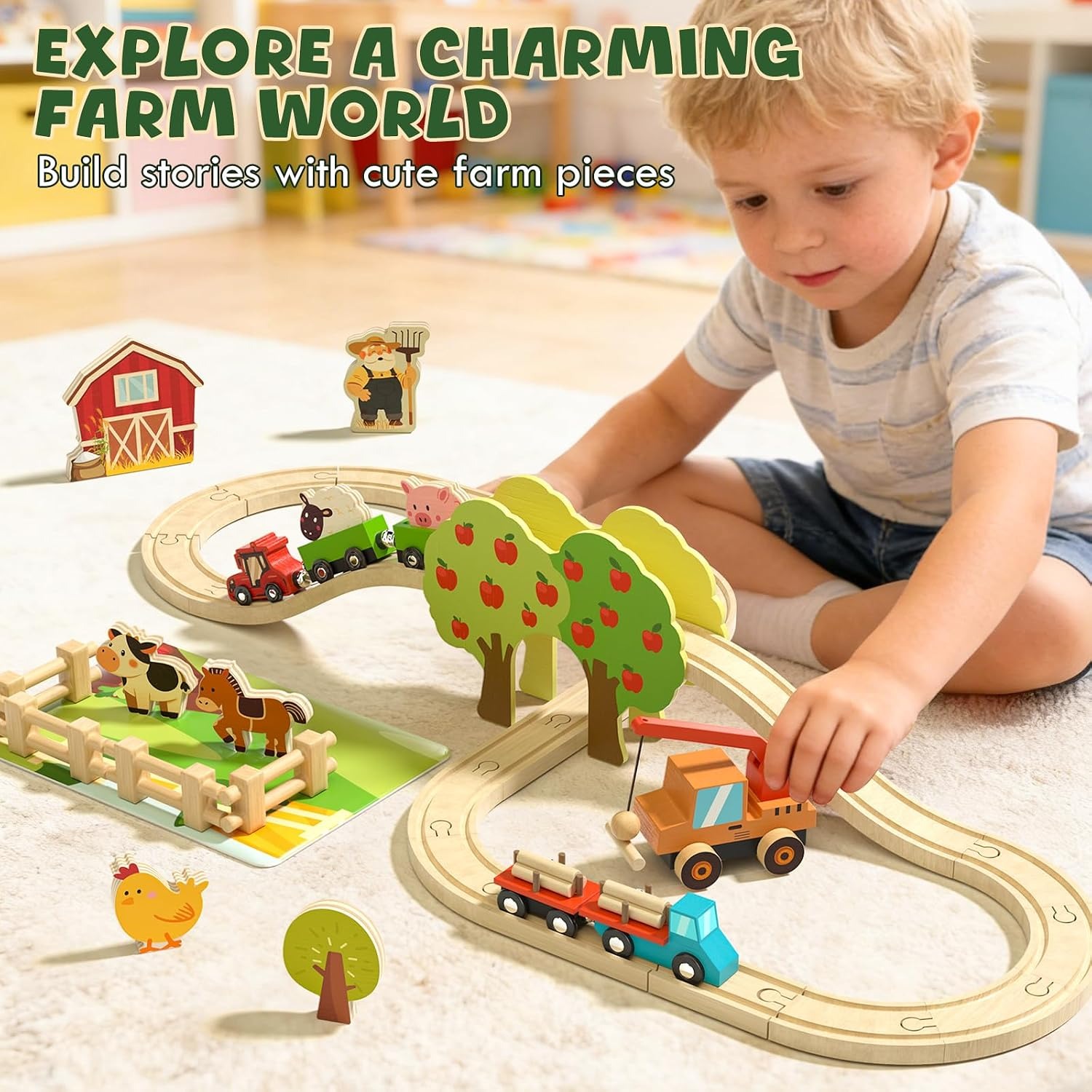
This set takes that approach with 47 pieces, built around an animal theme in a classic style. It is listed for ages 3 and up at beginner skill level, which is the sweet spot where a child can manage the track on their own but still wants someone to play with them.
How a wooden railway actually works
Wooden train track is one of the few toy systems that has stayed more or less the same for decades, and that is a good thing. Each piece has a peg on one end and a slot on the other. You push them together, they hold, and the carriages have wheels with a groove that sits in the channel. No batteries, no clips, no instructions.
That simplicity is why it works so well for small children. A three year old can connect two pieces of wooden track on the first try. A plastic clip-together system often needs more force and more precision than their hands can manage, which leads to the toy being abandoned in frustration.
This particular set is manual rather than electric, with no remote and hand control only. The child provides the power. That sounds like a downside until you watch it happen, because pushing a train by hand is what keeps them physically involved. Motorised trains do the fun bit for you.
There is a battery requirement listed, 2 AAA, most likely for a light or sound element on one component. The core of the set does not depend on it, so a flat battery will not kill the toy.
Why the compatibility line matters
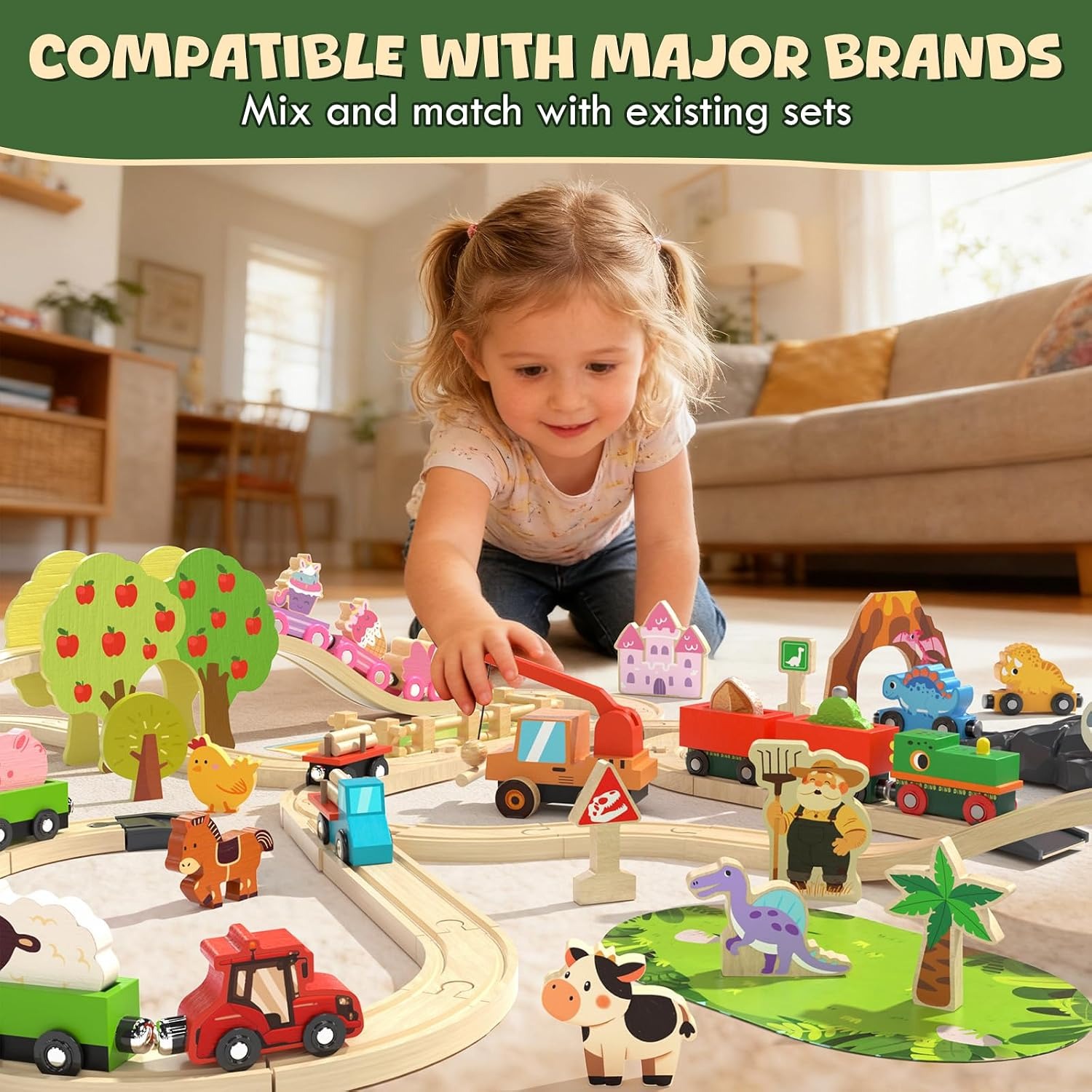
The listing says the set connects with most mainstream wooden train tracks. Read that twice, because it changes the maths on the purchase.
If a child already has wooden track from a previous birthday, these pieces slot onto it. The existing bridge suddenly leads somewhere. The spare curves that never got used become the long route to the barn. You are not buying a separate toy that competes for floor space, you are adding to something that already exists.
It also works the other way. Once this set is in the house, any generic expansion pack of straights and curves will extend it, usually for very little money. That makes a wooden train track set one of the few toys that genuinely grows with a child rather than being outgrown in a season.
If you are unsure whether your existing track will fit, look at the shape of the peg on a piece you own. The common profile is almost universal. Proprietary connectors are rare and obvious.
Who this suits, and who it does not
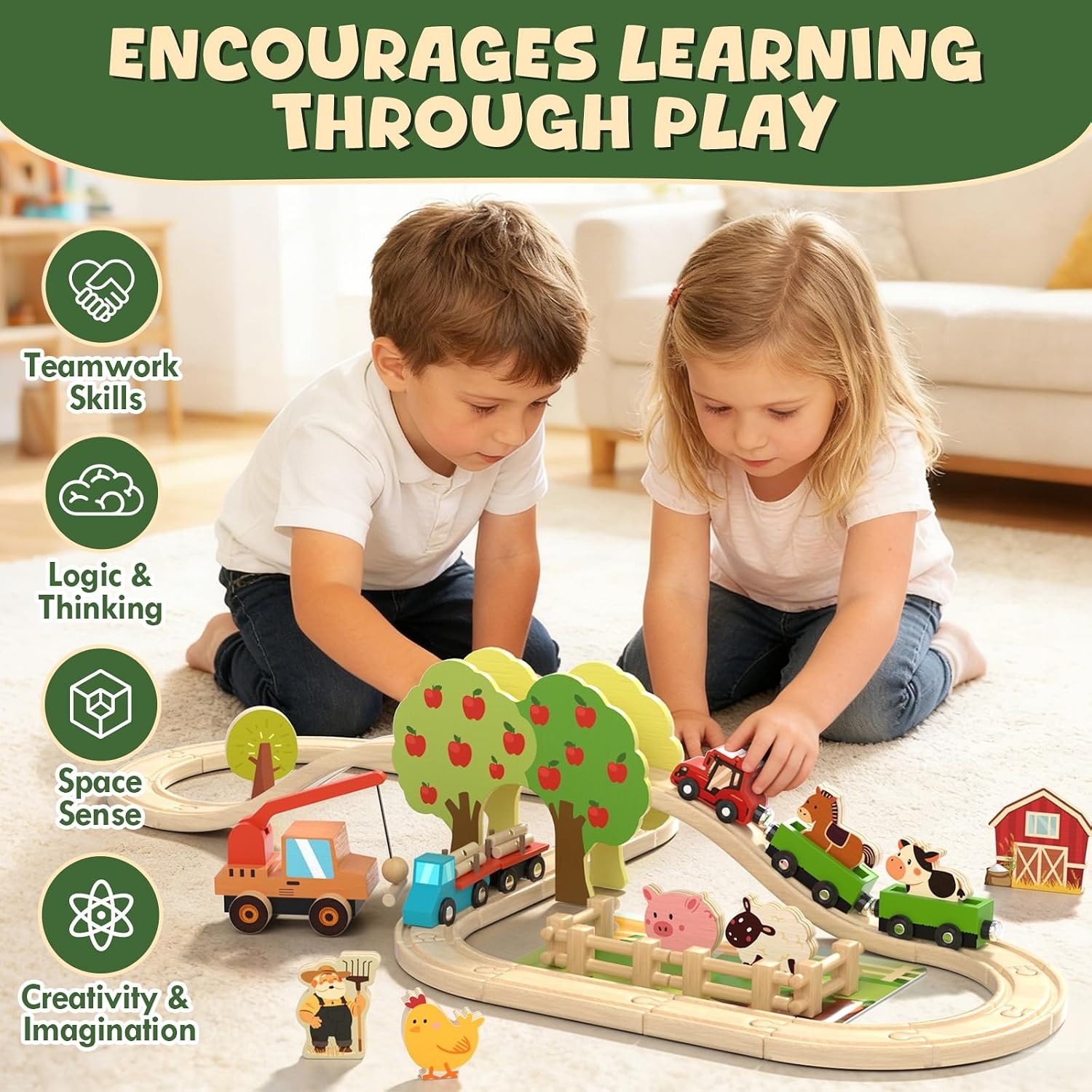
The best fit is a child between three and six. At three they are mostly laying track and moving animals around. At five they are building complex routes and inventing storylines where the train is late and the sheep have escaped. At six or seven the interest often shifts toward more detailed model railways, though many children keep coming back to a wooden set as the one they can set up without help.
It is listed as a two player set, so it is built for shared play. One child and a parent on the floor works perfectly. Two siblings works, with the usual negotiation over who gets the crane.
It is not right for under threes. The recommended age of 3 and up exists because of small parts, and the farm animals are small by design. If there is a preschooler in the house, plan for where the set lives when it is packed away.
It is also not the right choice if you want something that performs on its own. Nothing moves unless a child moves it. For some buyers that is the whole point and for others it is a disappointment, so it is worth being clear about which you are.
What to look at when comparing sets
Piece count against piece type. A set advertising 80 pieces might be 70 pieces of plain straight track. This one is 47 pieces across track, rolling stock and farm elements, which gives more variety in play than a bigger number of identical parts.
Whether there is a destination. Track alone runs out of ideas fast. Something to load, unload or arrive at is what extends the session.
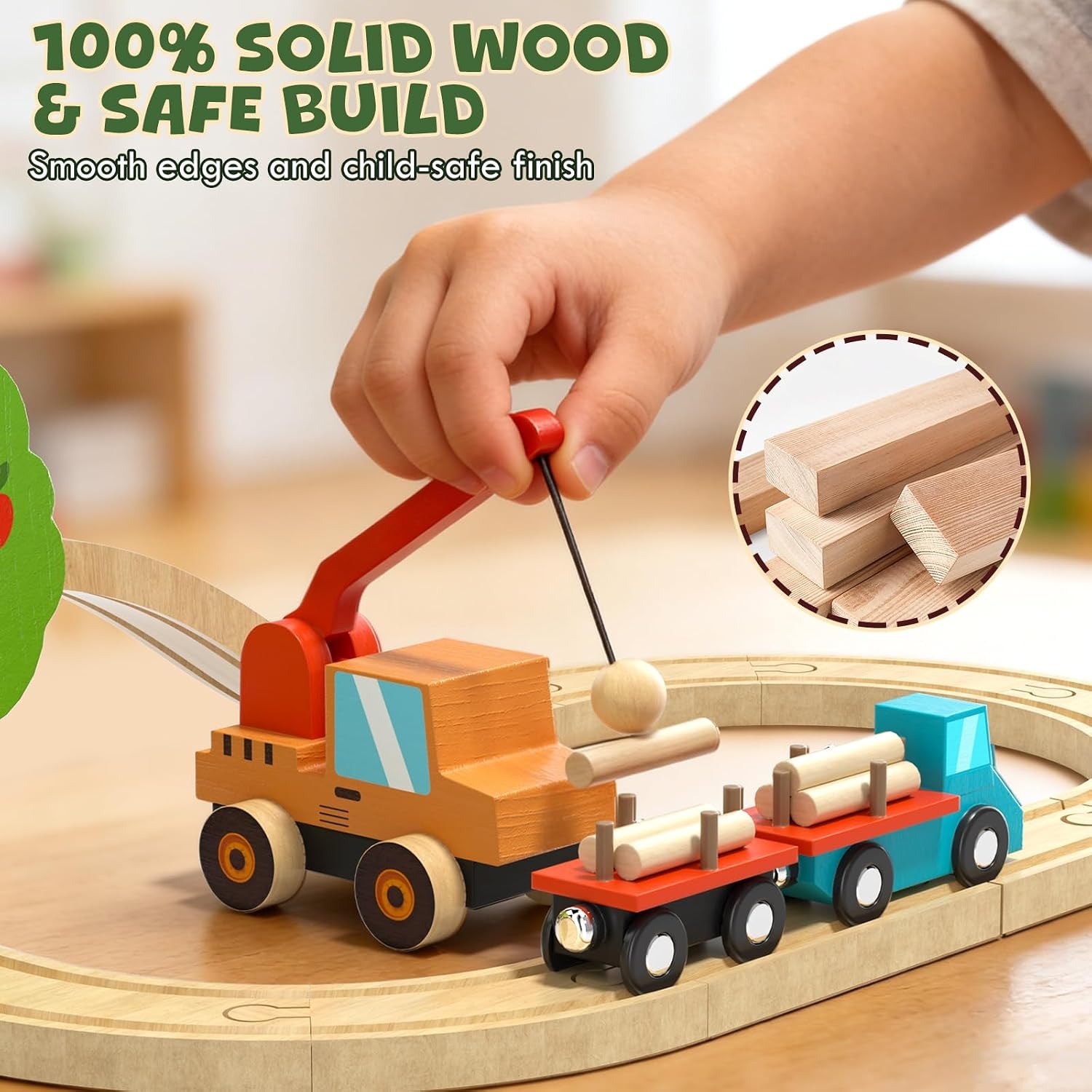
Material. Wood is heavier, holds its shape and does not skid on carpet the way hollow plastic does. This set lists wood for both the material and the frame. It also survives siblings better, which matters if you plan to hand it down.
Moving parts. A crane that lifts, a truck that carries. Those are the pieces children operate over and over, and they are doing fine motor practice without noticing.
Setup effort. Assembly here is listed at around five minutes with the included instructions. That is a one-time job before you hand it over.
Looking after it
Wooden toys are easy to maintain and easy to ruin, and the dividing line is water. Wipe the pieces with a slightly damp cloth, then dry them straight away. Never soak them and never put them anywhere near a dishwasher. Painted wood that stays wet will swell and the finish will lift.
Store the set somewhere dry, in a box or basket. Avoid leaving it next to a radiator or in a sunny window, since both will dry the wood out over time. If the set is going into storage for a few months, take the batteries out first.
Track ends take the most wear, because they get pushed together thousands of times. A bit of rounding there is normal and does not affect how the pieces connect. Check the small figures occasionally for anything loose, as you would with any toy for this age group.
The short version
A wooden farm train set earns its place because it gives the train a job. The 47 pieces cover track, rolling stock and a farm scene with animals, a barn, an apple tree and a working crane, so a child has something to build and something to do once it is built. It is wood throughout, manual rather than motorised, and designed to connect with most mainstream wooden train tracks so existing pieces can join in.
Recommended for ages 3 and up, listed for two players, about five minutes to assemble, 1.36 kg in the box. It is the kind of toy that ends up on the floor most afternoons rather than under the bed by February.